Showing posts with label cat welfare. Show all posts

Tuesday, July 21, 2009

ah ma & leukemia caregiver update

The woman was BANNED from Ah Ma’s place because she catnapped a kitten held hostage by that incorrigible hoarder.

So she kept away while Ah Ma fumed and hissed. (The kitten has since been adopted.) It looked safe to resurface again this week although Ah Ma, as befuddled as she is, remembered. Quite surprisingly, she only asked the other volunteers if the woman was there to take anymore of her kittens. They said no and they all moved on from there - Ah Ma back out to her favourite coffeeshop and the volunteers back to work on the cockroaches.

And it wasn’t even a surprise to find Ah Ma with 2 more kittens.


It’s tempting but the woman will try to accumulate more brownie points before pulling another catnap. After all, there is no end to the supply as long as people in the neighbourhood treat Ah Ma as a dumping ground. Since the start of the clean-up - 13 new kittens - 1 dead, 5 rehomed. The rest are where they are but thriving at least.


They headed over to the leukemia sufferer with 30+ cats after Ah Ma’s. The situation was already very much under control with most of the old furnishings cleared out and adult cats sterilised.

The old auntie was tired, overwhelmed, almost resigned. One kitten, degenerated to skin on bones, had to be rushed to the hospital. The others were in fairly good shape but teary. In her state, the soul is willing but the flesh is weak. She is just not able to keep up with the care the little ones need right now and we are desperately seeking new homes for these sick babies.


As soul-gutting as these cases are, it is hard to be upset with these old caregivers turned hoarders. No one taught them any better. And they themselves suffered enough for it. So I save my wrath for the ones not sick, not old, just dim, who cling on to archaic ideas that cats must roam and that neutering is evil and immoral.

On one of her trapping days, the woman had to fight off a teen who insisted one of the trapped cats is his. When it roams, pal, it is fair game. She offered free sterilisation for his other 2 cats. He said no. She shrugged. She will get them on their next wandering.

That makes 15 new young cats discovered, caught and sterilised this month alone. 50 and counting since January in a 10-block area. Half of them from homes. It’s hard to reconcile sometimes why we have let other people’s responsibility become our own. But in cat welfare, their problems often become yours. After all, if they are not sterilising, they are either a hoarder or a chronic abandoner and some one has to pick up their pieces eventually. We can at least take heart that some people are coming to their senses before it is too late.

And quite unexpectedly, they become your newfound cat welfare neighbourhood watch. This one-week old kitten was dumped next to a dustbin wrapped in a tissue and saved by our neighbour’s 7-yr old daughter.


It is with the vet, fighting for a chance on this callous earth.

How you can help:
* Donate cat food.
* Foster or adopt a kitten.
* Sponsor the medical fees for the 2 hospitalised kittens.

Friday, July 03, 2009

mystery call to AVA

An AVA officer got a mystery call today at their Toll-free Hotline for the loaning of cat traps from a particularly exasperating caller. He didn’t know he was conversing with a cat, masquerading as a cat-hater. That would have made his day.

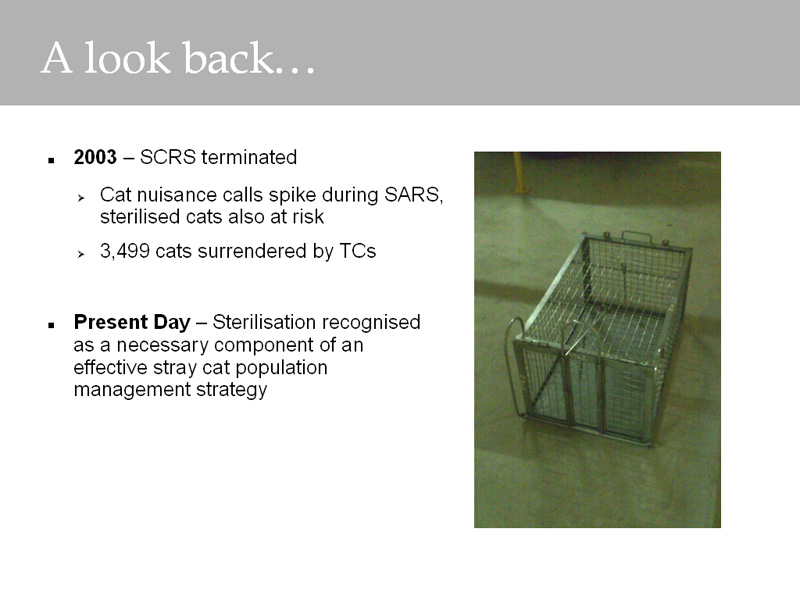
The bare facts are such: The loaning of free traps from AVA is open only to people living in private residences. They will need to present their IC at the Centre for Animal Welfare and Control for collection, where they will be shown how to use the trap. Only one trap can be loaned at a time by the same person for a period of 2 weeks.

Here’s where it gets interesting. I asked what happens after a cat is trapped and the officer said that you must call AVA to collect the cat by the next working day. I asked what happens to the cat and got the obvious answer. I then said that some family members are not comfortable to send cats to their death, can we catch and release them in other areas? The officer strongly discouraged this on the grounds that the cat may be disoriented and cannot find food, leading to suffering.

Tooty the exasperating caller then asked, but you won’t really know what people do with the cats after they are trapped right? The officer was getting slightly alarmed saying have you seen cats getting skinnier and skinnier if cannot find food? At least when it goes to AVA, it will be at peace.

The system certainly sounds good on paper, AVA provides free service to private home residents, nuisance cats removed to a misery-free end. Win-Win.

But so many questions unanswered. How do you ensure that the trapped cats do end up in AVA? How do you ensure that the trapped cats are properly treated overnight, over weekends by trappers who have no love for them?

Someone with a private residence address should go down and borrow a trap to see what information is being imparted to trap loaners. Cat Welfare Society has broached to the Ministry of National Development before to provide information about Trap-Neuter-Return-Manage as an alternative to culling. Whenever someone requests for a trap, AVA can inform people about sterilisation as an alternative, or send a brochure along with the trap. Has this advice been trickled down to the ground staff?

The officer obviously feels for the cats but his hands are tied by a system that is clearly flawed. He was getting annoyed by this heartless caller and hung up even before I said thanks and goodbye. Good for him.

Friday, June 26, 2009

CWS: A Look Ahead

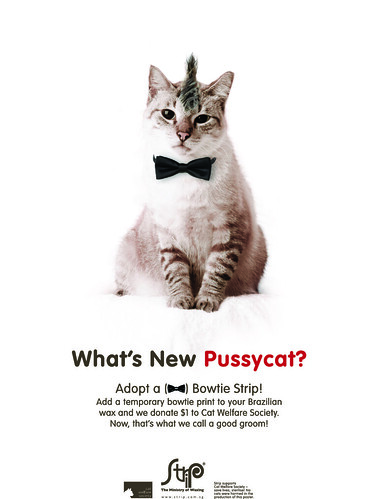
Cat Welfare Society has had a solid month of fundraising with the LPN Cat Day at Suntec City, the Cat’s Night Out “In Search of the Most Beautiful Domestic Cat” at Jurong Point and that unforgettably tongue-in-cheek STrip “What’s New Pussycat?” campaign.


Besides raising funds for stray sterilisation, these light-hearted occasions gave us a rare chance to let our hair down with other cat groups, volunteers and with the public.

Now the fun is over, it is time to get back down to the serious business of cat welfare.

Engaging govt agencies

CWS is planning a series of engagements with AVA, HDB and Town Councils. And it cannot be timelier that Sunday Times dedicated a full page on animal welfare last weekend, giving voice to the poisoned bayshore cats, abandoned animals and tireless animal welfare volunteers.

(They had to juxtapose it with an article on our good friend Mr TTK to provide a perfunctory journalistic balance to the spread, but that is easily forgiven. A contrary article on a less controversial figure would have been more detrimental. So thank you, Sunday Times.)

Also featured in the full page coverage is a small victory for cat welfare. AVA has put it on record, “AVA… is again open to subsidising the cost of sterilisation of stray cats, if caregivers, town councils and communities are willing to participate.”

So our upcoming meeting with them can now fast track to the mechanics of the stray cat sterilisation scheme: what is required of town councils and volunteers, and how to streamline the scheme for greater success.

After which, we can start working with dedicated caregivers whose stray management work in their areas through Trap-Neuter-Release-Manage or TNRM, mediation and community building work has reached a healthy maturity. We will talk to their Town Councils first.

How you can help:
If you are a caregiver with a well managed cat community, come forward. Also start keeping records of the number of cats in your neighbourhood, the number of cats you have sterilised, your encounters with Town Councils and the number of complaints handled as these will go a long way when we engage them.

If your area does not have a TNRM programme, start one! Look out for our upcoming stray cat management workshop and meet-up on how to get started.

Sterilisation

CWS continues to single-mindedly put our funds into subsidising the sterilisation of stray cats. All our fundraising efforts are for this very purpose.

We get appeals from time to time to provide financial help for caregivers in need and for cat rescues. And this the committee members and volunteers do on our own personal basis.

The reason CWS funds are not diverted that way is this: The cold honest truth is that we have had to dig into our reserves last year to cover sterilisation and medical subsidies. And one had to go. It is a sign of the times that donations are down and reimbursements for subsidies are up.

We must keep stray cat sterilisation going simply because sterilisation makes the biggest impact to the welfare of our cats in the long run. It is this consistent, demanding, unglamourous work by dedicated caregivers and volunteers that provides a compelling reason for AVA to enter into a dialogue with cat welfare advocates. And we cannot afford to derail now.

The moment the government finally takes on the funding of stray cat sterilisation, that will really open up everyone’s resources to help the sick and suffering.

That moment is close and what will get us there is to make sure more community cats are sterilised and managed.

How you can help:
Start a TNRM programme in your neighbourhood. The next best thing is to sponsor a sterilisation!

Mediation

This is something that we struggle with immensely because we don’t have a full-time person in CWS. The committee members and volunteers handle our cases after hours or through phones and emails.

Mediation remains the most stressful, unrewarding part of cat welfare work. Being yelled at by irate people with cat pee on their slippers after a long day at work is not anyone’s idea of a fulfilling existence. But we still do it, together with our network of caregivers and volunteers because it goes hand in hand with TNRM. Stray management just doesn’t work without it.

What we find is that people come to CWS for a magic pill. And five after-hours dispensers to pill an entire nation is beyond ridiculous. We need more mediators.

It is a fact that Singaporeans hold an uncanny esteem for authority. People from an organisation are often seen as more respectable than someone from the neighbourhood. That is how Singaporeans work, so “I am from Cat Welfare Society” goes a long way. But anyone with the passion, a little gumption and knowledge can register with CWS and fulfill this role. And all the better if they are actual residents in the neighbourhood.

These resident mediators have their nose on the ground, they get to the problems quicker and they can better establish long term relationships with the Town Council officers and other residents. Town Councils can’t ignore them simply because they are residents, therefore constituents and more importantly, voters.

The magic pill? Don’t yell back and don’t wear your house clothes when mediating.

As much as mediation is daunting and completely thankless, just a word from you can save a cat from being caught and culled. If you are lucky, you can instill a little conscience in the neighbourhood, one cheesed off resident at a time.

How you can help:
If you want to be a mediator for your neighbourhood, register with CWS and contact your Town Council officer. Also look out for our upcoming stray cat management workshop and meet-up on how to get started.


Beyond CWS

If you have been following the posts and thread on the Cat Welfare Society’s Facebook page, you would have a good idea of the spectrum of cat welfare activities required to fully tackle an issue as broad as cat welfare.

There are the numerous appeals for medical fees for sick or injured cats, the many catteries and shelters in trouble in these tough economic times, cats and kittens that need fosterers and homes, AVA officers and Town Council officers to negotiate with and the unenlightened public to educate. As individuals, where do we start?

My own experience with the animalfamily is to start where your passion takes you. I started with the rescue and adoption of an old mangy toothless cat that stole my heart.

6 years on, the family has 10 cats at home, 40 cats fostered (and thankfully rehomed), hundreds sterilised and we dream of a cattery. We have seen cat shelters and their antithesis, cat hoarders and left a part of ourselves with each and everyone of these animals, the cheery ones, the sadly neglected, the dying and the dead.

Still, it is not enough. There must be a more sustainable solution to the plight of our cats, the kind that makes it less necessary to take cats off our streets for anything other than to loving homes. This will happen only when the responsibility for stray cat welfare is not just on caregivers but the entire nation. That is the prize worth working towards.
Tuesday, May 26, 2009

Singapore Animal Welfare Symposium 2009 II

The Cat Welfare Society gave a presentation as part of the second panel session on Domestic Animal Welfare. It raised up our community's two main issues - that HDB allow cats to be kept as pets in flats and the reinstatement of the stray cat rehab scheme - amidst positive evidence of the effectiveness of sterilisation and a growing community of cat caregiving and advocacy in Singapore.

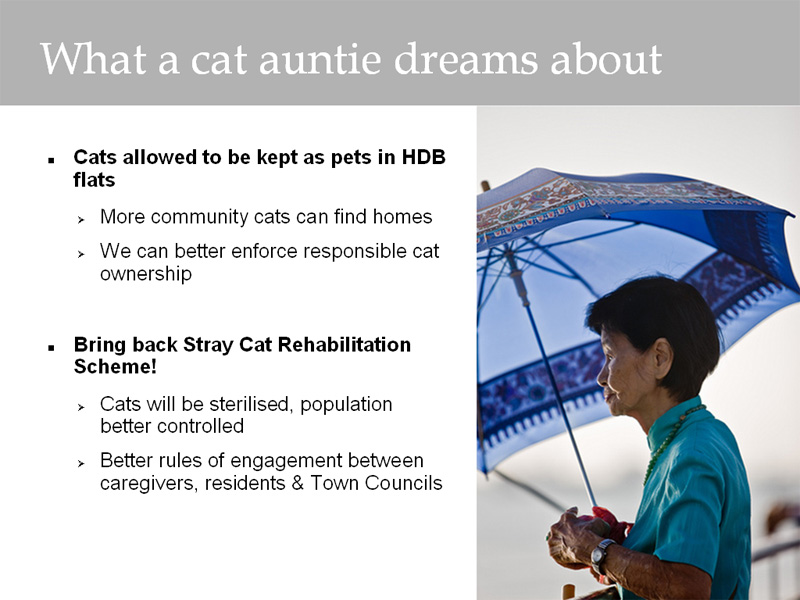
Can we make a cat auntie's dream come true?


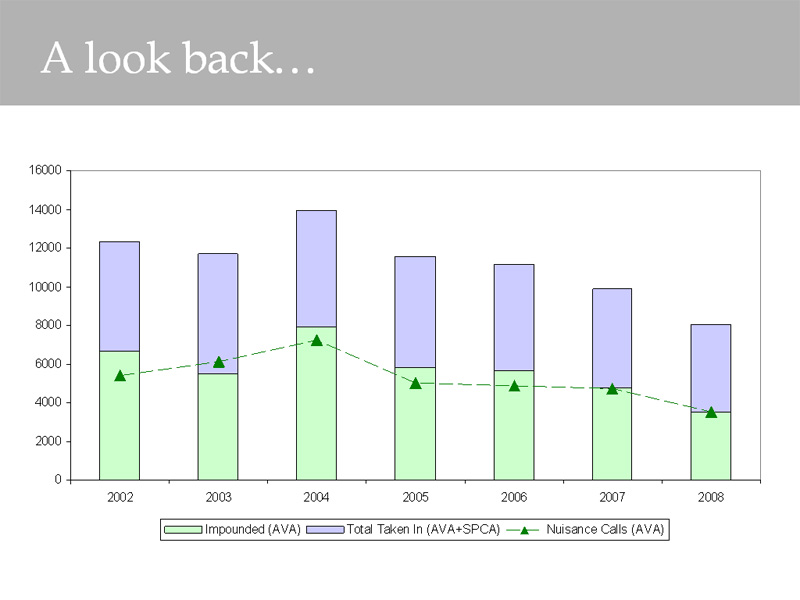
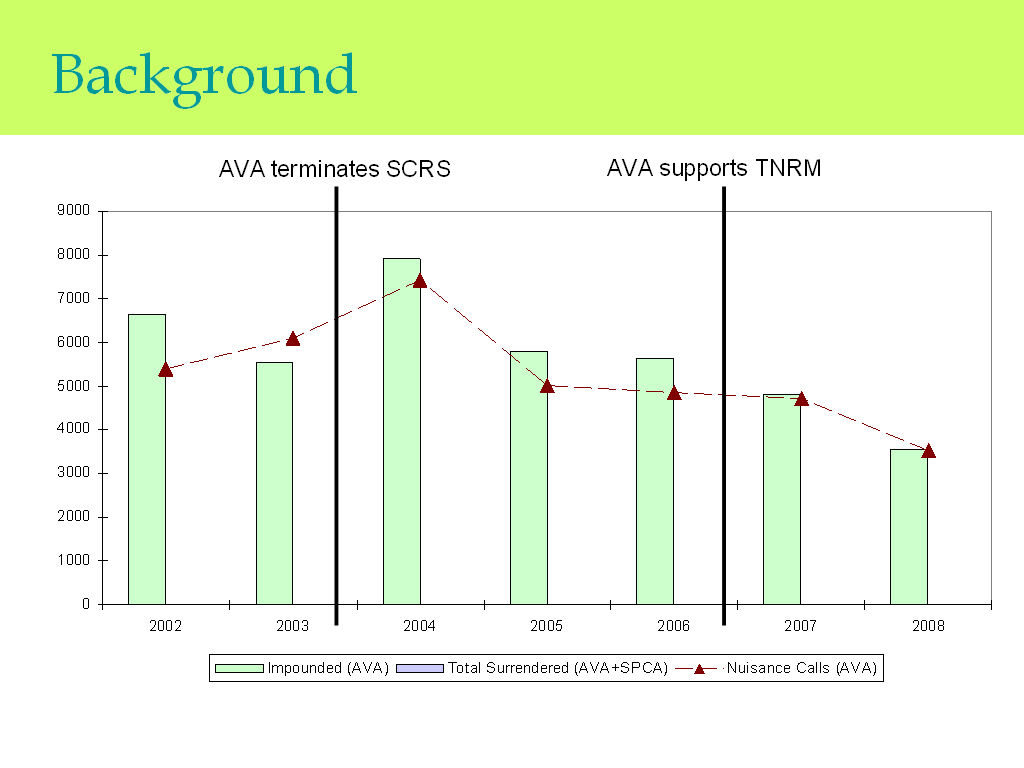
Since 2004, there has been a year on year drop in the number of cats surrendered and impounded.


Long overdue, these caregivers are starting to receive well-deserved recognition in recent years.


So, what do these community cat caregivers want? They want more eligible homes for community cats. And they want to know that their cats are safe from being indiscriminately caught and culled.


While stray cat population figures show that sterilisation is effective, what it doesn’t do is reduce the number of cat nuisance complaints, which is constantly cited as one of the reasons for resisting cat-friendly policies.


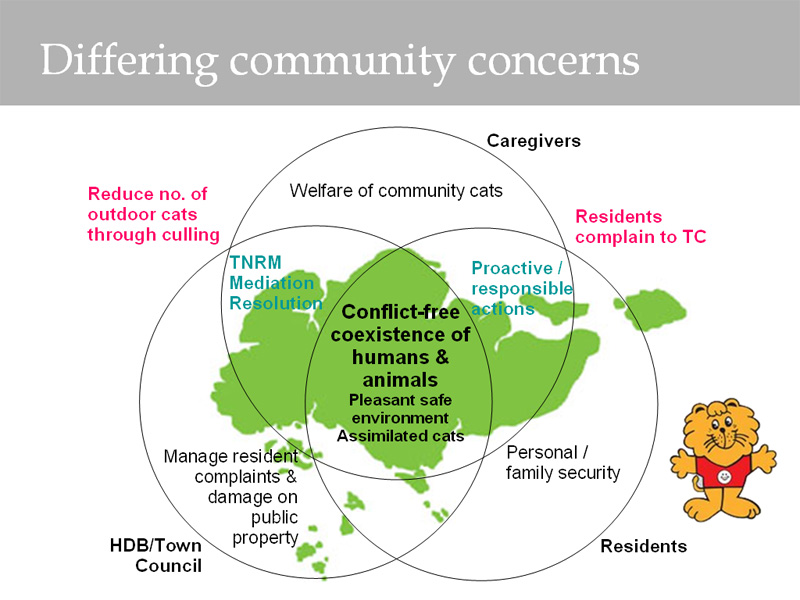
On the ground, there are many parties and their differing concerns to balance when trying to achieve an amicable level of human-animal co-existence. A lot of the resistance to the reinstating of the Stray Cat Rehab Scheme is from the town councils who are skeptical about how the scheme benefits them and also the additional workload that comes with administering the scheme.

(AVA confirmed that if they were to bring the scheme back, it would be in a decentralised form and only with the consent of the town councils.)

It reinforces the point that helping town councils reduce instances of human-cat conflicts is paramount in winning them over. And that is a task that CWS will take up this year. It is making plans to engage HDB, MPs and TCs and call for like-minded people in this community to come forward with inputs and support towards this campaign.


In contrast to the stray cat, stray dogs remain far less tolerated on our streets. The govt still does not recognise the same trap and neuter programme for our canine friends. Yet the pet dog trade trumps the cat anyday.

Singapore being a free market, the govt does not interfere with the market supply of pets from breeders or in pet shops. Many advocates argued that more must be done to curb the supply, especially in the face of a growing number of abandoned pets in Singapore, many more dogs and an alarming number of pedigrees.

This would be music to our ears certainly but as unlikely as it is that the govt will restrict the trade in pet animals, they must at least answer for how well these animal traders are being policed. It became clear that AVA relies on whistleblowing to keep these traders in check.

As the day progressed, several areas of overlap surfaced that animal welfare groups could potentially collaborate on:

1) Allowing more categories of pets to be kept in flats like cats and medium-sized dogs.
2) Regulating the loaning of traps to the public for errant cats and monkeys.
3) Policing of unscrupulous breeding and trading of animals.

To their credit, AVA indicated a willingness to continue the dialogue beyond the symposium on many of the issues raised. One person from the floor said it best. She asked AVA to tell us how we, the animal welfare community, can help them make some of these long-awaited changes a reality. And this is an opportunity that AVA cannot quite afford to pass up.

Students made up a large percentage of the audience at the symposium, many recipients of the animal protectors grant with an impressive showing at the event. These student leaders and activists with a passion for animal welfare are likely to become our next generation of veterinarians and advocates. If AVA wants these future leaders in their fold and not on the opposite side of the table, this is the time to engage them.

And what these students want is the confidence that the govt and its policies can change. More than that, what they want is to be part of the movement that leads and that inspires the conscience of this country for animal welfare and for conservation, not trail behind it. You can just see it in their eyes.

Tuesday, May 12, 2009

let's start a revolution

These are exciting times for cat welfare volunteers, supporters and activists. In the beginning, they started websites, then forums and they blogged. Now more than ever, they have organised themselves into a remarkably coherent voice for the common community cat in our communal void decks and on our collective streets.

The woman remembers that singular moment when her flame for cat welfare was fanned into burning scorching action. That was 5 years ago when Maneki walked into her life. Back then, it was tough to get started. Cat Welfare Society helped by providing starter packets of information but because there were never enough people to start a TNRM group in this area, it didn’t make sense for CWS to come down to conduct workshops or to make contact with the town council.

The woman had to find her own way, attend a TNRM workshop in NLB, loan a couple of traps, make herself useful to the town council officer and just get on with it.

Blogs and bloggers certainly helped along the way but cold hard information was tough to come by to paint a coherent picture of how we arrived at the present milestones in cat welfare, who are our minor and major movers in government and civil society and what are the common goals for the future.

It is truly only after Facebook and the flowering connections it proffered that this organically emerging animal welfare ecosystem in Singapore is crystallising in a way that this feline hopes will inspire progressive thinking and greater action in Singaporeans for us Singaporean cats. Facebook connects people, their human faces and their stories on a level that surpasses their carefully crafted words that make up websites, blogs and forums. This has done more to move bodies of knowledge around at great speeds without saying any much more than people are already doing.

So if you haven’t found your way onto the bandwagon, maybe this is the time.

This blog has been featuring links to other animal welfare groups in Singapore since forever, it also spots a blogroll that I have just split into a local list and the rest of the world so that it is easier to monitor our very own catty echo chamber of meows and grunts.

If you want to join the revolution that is happening online, here is a list of Facebook groups that you can hook up with for starters. Perhaps by chance or design, we might become mutual online friends and fans and I look forward to that.

Organisations
Cat Welfare Society Page / Group
SPCA Singapore

Issues
Appeal to the AVA to Stop the Free Loan of Cat Traps
Cats in flats...
Support Pet Shops that Do Not Sell Pets
Stop Culling and Revive Stray Cats Rehabilitation Scheme in Singapore
STOP the culling of stray cats!

Support Groups
Cat-CareGivers' Support Group
Cat Fosterers (Singapore)
TnRM (Singapore and Malaysia)
Singapore Adoption Group

Student Groups
Cats Management Network
SMU Paw
NUS PEACE! People Ending Animal Cruelty and Exploitation
NUS Cat Cafe

Other Groups
Cat Absolut
Paw Pledge
MettaCats
Blessing Home

General
Cat Lovers Singapore
Singapore Community Cats

Saturday, April 04, 2009

we are more human in a crisis

The reality of 2009 has hit home. Charity organisations are looking at their financial year-end balance sheets and balking. Donors, volunteers, are looking long and hard at their own finances and commitments. Many have lost jobs.

Animal welfare is perhaps the hardest hit for its very nature. TNP recently threw a spotlight on a jobless man in Ang Mo Kio who has 80 stray cats under his care. Reactions to the story echo a general public sentiment that the jobless man and his kind are out of their blinking minds, spending money on CATS of all things in this crisis where so many people could use that extra lifeline. This sentiment spills over to animal welfare work on the whole.

It often escapes them that quite simply, cats don’t eat money, nor dogs, birds, sharks or whales. We might try it for a lark but still perfectly legal tender following a rinse after regurgitation.

We merely ingest a small measure of raw materials that money can buy. The bulk of the money spent goes right back to people, and lots of them. If spending is the way out of this crisis like we keep getting told, animal people are certainly no small part of that equation!


Lucky for us, our caregivers are legendary for their single-minded obstinacy. No job, no money but don’t even think about suggesting that they discontinue their feeding rounds or with TNRM. They know enough from watching their cats how to gnaw the thinking parts off a cold hard household pest.

These aunties and uncles are the very people carrying the brunt of a country’s uncertain economic future, but somewhere along the line, they rejected everything that this society has taught them and made the conscious, unwavering decision to focus on something outside of themselves rather than their own problems.

In a crisis, they become more resourceful, more willing to ask for help, forming their own network of collaborators and sponsors, and taking advantage of all available subsidies from organisations like SPCA and the Cat Welfare Society. And they are doing it in english, in mandarin, in malay, in tamil and several dialects.

The way a Toa Payoh caregiver sees it, “When you have money, you have no time. When you have time, you have no money.” So they go about joining the dots between the people with money and the people with time.

All the more, they look to animal welfare organisations to provide a level playing field with their programmes and subsidies. These organisations are able to connect recipients with donors on a far larger scale than any individual or group, to the combined tune of $110,000 last year for cat sterilisation alone. This is up from $90,000 from the previous year.

And they need to meet this growing demand in good times and in bad.

If you are surviving the crisis with a little extra in your pocket, please consider giving to the SPCA and the Cat Welfare Society. Cats don’t need your money but the uncles and aunties who love us do.

Tooty would like to thank the generous people out there who contributed to the hoarding case. In particular, Cat Welfare Society, Paw Pledge and the anonymous individuals all the more noble for their anonymity.

Saturday, February 28, 2009

conversations on cat welfare II

Several significant connections were made at the cat welfare meeting between active individuals immersed in cat management in one way or another – TNRM, rescue, fostering, feeding.

Beyond cat management practices, potential advocacy and education/awareness platforms were shared and discussed. These ideas are being ironed out before they can be usefully shared. There is one they can start working on that will benefit from inputs from the wider cat community – you.

They plan to produce and disseminate a smart little booklet for general public consumption. More specifically, for people who don’t like cats. The booklet will educate, entertain and more importantly, provide practical, humane solutions for avoiding cat encounters on the streets and on their lawns.

This, it is hoped, will work towards reducing human-cat conflicts. Working on it might even open cat advocators’ eyes to the predicaments of those who find us less than adorable, even sinister and menacing. Frustrating as their phobias and prejudices are, bashing them really hasn’t gotten us any further along in our goals of getting cats into HDB flats and for the government to stop culling. Satisfying, yes but here’s the much needed Plan B.

Through the next few weeks, drafts of the book will be put up on this blog for comments. The woman’s initial thinking is that it will be in a no-nonsense B/W format downloadable online, also easily printed on any printer by anyone and freely given out to family, colleagues and neighbours.

Owing to her animal welfare and eco interests, the woman has had the good fortune of meeting many socially conscious, passionate people like the cat activists and volunteers who attended “Conversations”. Justifiably, she has been encouraged to think that perhaps people in Singapore of her age and younger are differentiating themselves from those before them by becoming more engaged and more involved in the social and in the political.

If you think the same, you would be wrong. Findings from a recent study on local Y-Gen’s attitudes will knock you off your feet. Y-Geners (born 1977 to 1997) are found to be a very pragmatic lot – they want remuneration for their work. No surprises there. Yet while ability to make decisions and implement changes is cited as the main reason for choosing not to work for the government, a whopping 77% indicated that they should not have a voice/say in any government policies.

So let there be no lingering delusions of grandeur for us rabble-rousers. We have no audience. If the message is too robust for local sensitivities, we will be like a posthumously decorated JBJ making his final stand outside Raffles City, ignored.

That's why the book idea is worth a fair shot. Cat advocators need to speak the regular language of the general population and of the government. As important as words like ‘compassion’, ‘karma’ and ‘rights’ are, they really only work in novels, on TV series and in America. They don’t work in campaigns, on letters and in forums simply because they are too elusive, too vague to bridge the psychological gaps between the 23% and the larger 77%. we need grounded words like 'responsibility', 'co-operation' and 'mutual benefit'. It’s worth thinking about.

Friday, February 20, 2009

conversations on cat welfare

the cat blogosphere has been ablaze with fresh activity since ava’s banal “no easy response to stray cats” rejoinder to the spirited TODAY feature on Dr Tan Chek Wee “the outspoken doc”.

the govt’s arguments about cats being a nuisance and hazard are laundered yearly right down to its bare threads and so past its sell-by date, it’s heartening to see people still with politically-correct words left in their defense. i only have one, @#%.

then the grisly discovery of 45 cats buried in seletar stunned the nation. cat lovers grieved. seletar residents fretted. cat non-lovers were appropriately respectful. the media prepared for a bonanza. and how the authorities must have braced themselves for an impending public relations problem.

true to fashion, TNP sold many papers with their provocative features on cat aids and Tony Tan Tuan Khoon. they freaked the public and gave Tony and cousin Choo their cringe-worthy airtime. but they also ignited a coherent campaign against govt funding and support for vigilante cat trapping by ordinary citizens that might actually stick.

it is a point worth driving home to the powers upstairs: rubber-stamping culling as a reasonable method of reducing strays spawns the likes of Tony, one civic-minded law-abiding poster boy no respectable govt agency wants to be associated with.

while the cat community keeps the dialogue alive on blogs, on forums, on facebook, perhaps it is time for a parallel approach. as we continue the battle of words, letters and petitions, perhaps it is time to see it from the govt’s perspectives and offer concrete solutions to the sticky issues that they cite time and again as deterrents towards more progressive and humane policies. and this may actually require working alongside the govt to tackle their pet issue – reducing public complaints on strays. it’s a tall order but one worth pursuing.

already, AVA numbers show a definite down trend in nuisance calls. CWS should take the credit for that for their relentless effort in engaging TCs and AVA, providing support for caregivers and channeling resources to education, mediation and to sterilisation. that barrel needs to keep rolling.

and still there is always room for fresh ideas and platforms if the right people can come together on it. and that is where “Conversations on Cat Welfare” comes in. we are meeting tomorrow 21 Feb 3pm at Food#03 on 109 Rowell Rd.

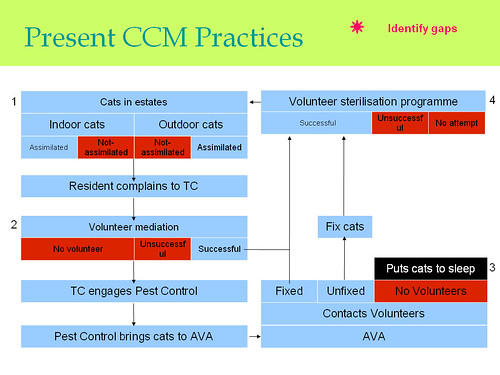
this informal meeting hopes to identify current gaps in cat welfare practices, areas of collaboration and ultimately spin off projects that will help the cause. these can eventually be taken up individually or collectively.

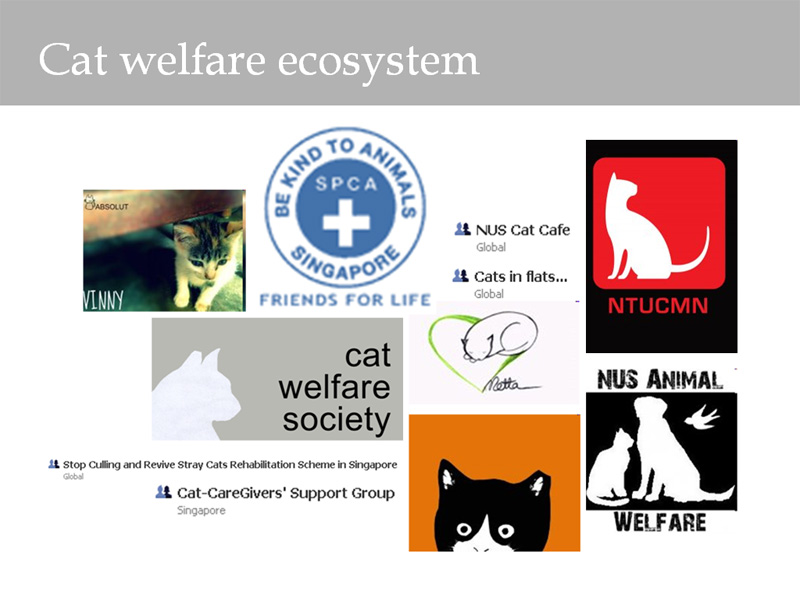
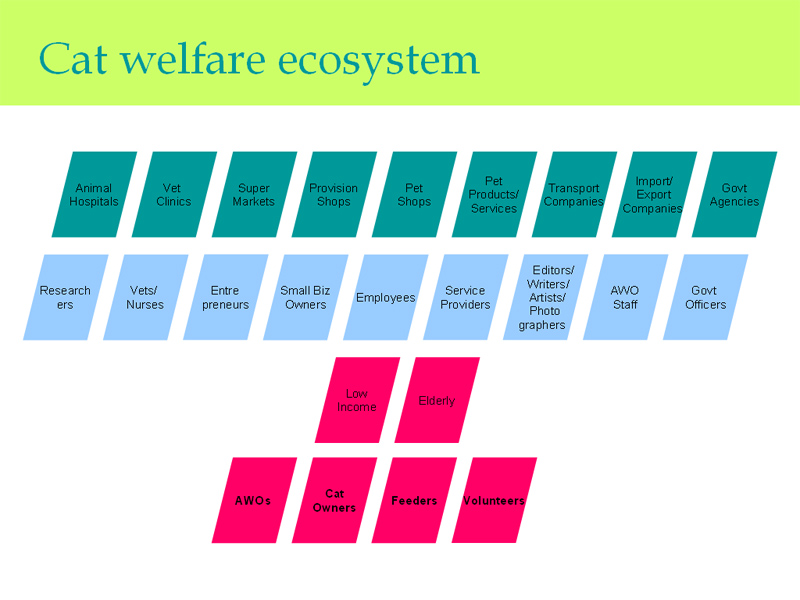
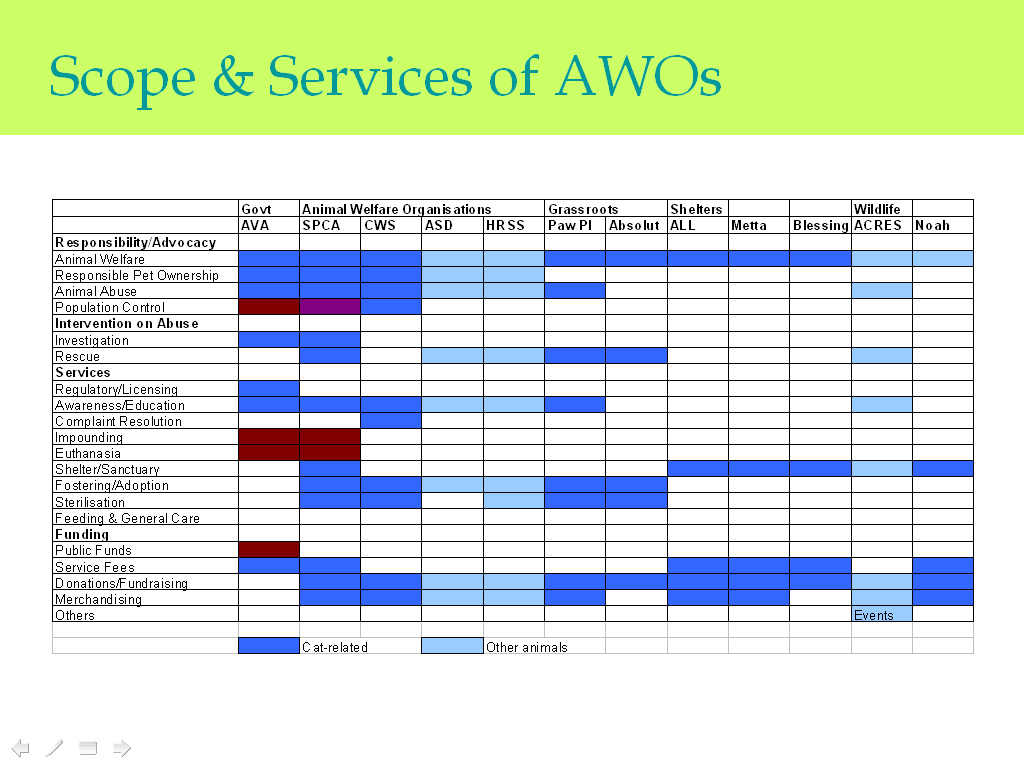
to start the ball rolling, some information has been collated to provide perspective on the cat welfare ecosystem in singapore. this is by no means complete and inputs are welcomed to make this a robust repository for the benefit of everyone. if anything, our message is that it is time for the cat community to work together despite differences, share information as much as possible and to support each other’s ideas and efforts, because the stray cats downstairs can only benefit from more of them, not less.

click on images to enlarge
CCM = community cat management
AWO = animal welfare organisations


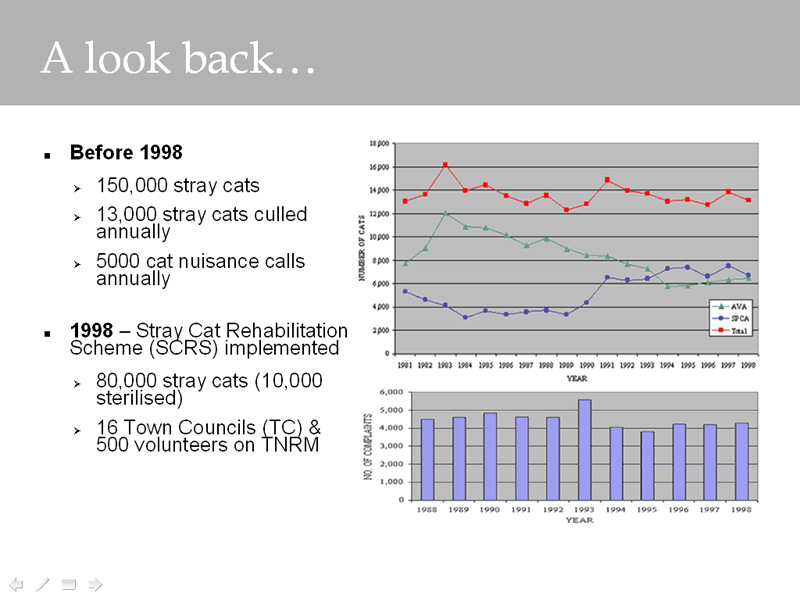
Before 1998
*150,000 stray cats
*13,000 stray cats culled annually
*14,000 cat nuisance calls

1998 – Agri-Food & Veterinary Authority of Singapore (AVA) (then PPD – Primary Production Dept) implemented Stray Cat Rehabilitation Scheme (SCRS)

2001 – 28,000 stray cats impounded

2003 – AVA terminates scheme
*80,000 stray cats (10,000 sterilised)
*16 Town Councils (TC) & 500 volunteers on TNRM
*Cat nuisance calls spike during SARS, sterilised cats also at risk
*AVA & TCs culling bill up 20% ($62,000) to $598,944 to catch and cull 7,682 cats and 4,744 dogs

2006 – AVA supports sterilisation by volunteers with subsidy and communication to TCs


if you have an interest in cat welfare, feel free to come join us.

Tuesday, August 26, 2008

proud to be a cat auntie

if you have been following the local cat blogs, you might have heard about a hoarding case of an old woman in a roach/maggot-infested 3-rm flat, which she shares with 40 unsterilised cats, 2 dogs and 2 tortoises.

it is rightly called a house of horrors, with black streaked walls, cobwebs, flying roaches, sick animals, dead animals, broken tiles over which animals defecate, everywhere. and in the midst of all these, a stubborn cranky suspicious forgotten old woman.

a couple of cat aunties discovered this and with understandable trepidation but unusual courage, took it upon themselves to help her. jamie and janet, i don't know what classes you did at school, for darn sure, everyone else should have gone to the same!

they started the ball rolling and inspired a lot of people along the way to get involved, the woman being one of them. Babywail's Shelter gives a complete rundown of the events surrounding this case, Lynn being one of the pioneer volunteers herself.

for sure, a case like this draws much attention and on some forums, even on Lynn's blog, there has been some contentious comments. some said that the old woman should be locked up, some said the animals should be taken away from her, some said that the volunteers are taking things into their own hands and the authorities should be involved, one even hoped the old lady will die soon.

our woman won't even be bothered to answer the person who posted that last comment.

her initial reaction from discovering this case was also that the old woman should be in a home as she seems to have a condition, obviously can't take care of herself, much less the animals. but upon meeting the old woman, she did an about turn.

this old woman is far from being non-functioning. and the bond between her and her animals is undeniable. she is frail for sure but lucid she still is, sometimes to the point of sharpness. she understands, but she is unable. she feels, but she is resigned. she doesn't have a mental problem. she is just trapped in the unforgiving state of being old and alone.

the final nail in the coffin of despair would be to take away the last of her freedoms and in particular, the little ones who love her so dearly when everyone else had gone away. she simply needs warm human bodies with friendly faces and willing hands, which in a world population of 6.684 billion, is in short supply.

so until the day we have a solution for the helpless that wouldn't conclusively break their human spirit, no easy decision can be made in a case like this and for better or worse, the authorities and the organisations have stayed distantly silent.

and so the day is saved by a swat team of cat aunties armed with face masks, shower caps, mops and cat traps. partial to both human and animals, they don't choose one over the other and save them all. they fundraised, they scrubbed, they sterilised, they befriended. their special ability? having ears close to the ground (often an excellent source of information), great powers of persuasion (try outtalking a cat auntie), speaks all the local dialects, networks with handy people like taxi drivers and contractors, garang, gung-ho, and most importantly, not afraid to get hands dirty.

it is our hope that when the conditions of the flat and the animals have stabilised and the old woman's trust in people regained, people will come back, family, social workers, befrienders. in the mean time, she has the formidable cat aunties and that is nothing to turn your nose up at.

Saturday, June 14, 2008

bad tooty

oh my, has it been this long??

sorry my dears for not keeping up with this blog for a while. i blame our digital camera, which conked out on us and we had only our pathetic camera phone to fall back on. blogging just didn't seem worthwhile without nice handsome pics of the family to make all you people green with envy... :D

on the cat welfare front, the woman had some luck with the new TC officer who is sympathetic but understandably caught between a rock (the woman) and a hard place (cat hating complainers). sterilisation however, has been tricky as it is getting harder to catch the new younger cats in the neighbourhood. for some reason, they have become a lot more wary and clever, even of their feeders. a good combination for avoiding pest control but not good for TNRM. we had some luck with two prolific males that got hungry and complacent but at least three more are particularly hard cases that have time and again avoided capture. i don't think the conventional traps are working and the woman is on a look out for better ones.

on the home front, we are still an intact household of 2 beans, 11 cats and 1 leafty. it's probably time to update the "how we came by" section to add Tuxedo and Calico to the list as they are well and truly family now.

me slacking off

Chaplin is now our alpha male, never mind that he remains pint-sized compared to Papa, Bak Bak and Rosie. he even orders the woman around! so what do they say about size?

Rosie mellows with age... she is 6! we are sorry to hear about your brother baby blue who died of leukemia late last year. see you at the bridge, blue

Tuxedo graduates to adulthood

Thursday, October 18, 2007

eye of the storm

yesterday's storm flushed this little thing out from the drain. too sadly drenched for the woman to leave outside so she spent the night in the back room drying out... great timing for next week's Free Spay Day, actually. fingers crossed that we secured our slots!


Monday, August 13, 2007

honorary mention

"Our Town Meows" honorary mention goes to


Changi Village!

Monday, August 06, 2007

cat adoption contract


this is the cat adoption contract the man and woman use when we adopt our friends out to people. i have not known any one who has been brought to task on breach of this kind of contract in Singapore, for lack of legal grounds or lack of trying i don't know, but if you are in the business of fostering and rehoming cats, i think it is a good practice to be at least in agreement with the adopter about the care and treatment of the charges.

so with agreement and not enforcement in mind, our contract includes a laundry list of conditions, adapted from various sources, that are mostly useful/helpful but would be hard pressed for standing up to any scrutiny e.g. #3.

in some overseas adoption contracts, there is a statement that they are binding and enforceable under civil law. in view of that, they only include conditions of contract that relate to humane treatment with requirements for sterilisation and preventive medication for which there is a reasonable burden of proof, which makes sense. but until we know for sure that our civil law here would recognise such a contract or that it would not be negated because the adopter happens to be a hdb dweller, i guess ours will serve as well as any as a goodwill handshake and our friends will at least go out into the world with a little something more than a prayer.

Conditions of Contract

1. The Applicant agrees that cat will be kept as a home companion and will share Applicant’s home being given the same considerations, as would a human family member for the duration of the said cat’s life.

2. As such, the cat is to live in the same private residence as the applicant as companion animals.

3. To provide the cat with sufficient quantities of nutritious food and fresh water each day as stipulated in “Nutrient Requirements of Cats, Revised Edition, 1986; National Academy of Sciences, USA”

4. It is expressly understood that the Fosterer does not offer any warranty as to the physical condition or temperament of the cat.

5. The Applicant accepts this cat as is with all defects, either observable or unobservable, and assumes all risk and responsibility for the cat from the date of signing of this contract.

6. Never to strike or otherwise harm the cat.

7. Never to allow the cat to undergo any cosmetic procedures, surgical or non-surgical, such as declawing or extraction of teeth, unless for medical reasons at the advice of a veterinarian.

8. Spaying or neutering is required by five months of age.

9. To keep the cat indoors at all times.

10. Not to let the cat outdoors unless leashed and accompanied by the applicant.

11. Never to enclose the cat in a space smaller than 2500mm x 2500mm x 2500mm for a period longer than two hours a day.

12. Adopter agrees not to sell, give away, or dispose of the cat in any other manner (except euthanasia for medical reasons at the advice of a veterinarian) without prior consent in writing to the Fosterer.

13. To ensure that the cat’s vaccinations, as advised by the veterinarian, are current and to provide veterinary care upon sickness, disease or injury.

14. Adopter agrees that the cat will be confined in the house when there is no one at home, except for prolonged absences such as vacations when secure and proper care will be arranged for the cat.

15. To give the Fosterer visitation right at a reasonable time, without notice, to ensure that the terms of this adoption agreement are being observed.

16. If the cat must be relinquished for any reason by the Applicant, it is the Applicant’s responsibility to offer a Replacement Applicant.

17. The Applicant must seek the Fosterer’s consent to transfer responsibility for the cat to the Replacement Applicant. The Fosterer reserves the sole right to interview, approve or reject the Replacement Applicant.

18. The Applicant understands that it is illegal, by Singapore law, to abandon the cat.

19. If the phone number and/or address for the original Fosterer is no longer operative, the Applicant will make a good faith effort to locate and contact the original Fosterer.

20. To keep the Fosterer informed of any changes in the Applicant’s address or contact information.

Wednesday, July 25, 2007

exemplary community cats, exemplary communities

news release | for immediate release

the ministry of social concerns recognises that well-integrated community cats are a testimony of their community's cohesiveness, cultural tolerance and sense of responsibility.

in recognition of the efforts of the exemplary townships that have overcome great odds to keep their cats tipped, fed and safe, we hereby present them with a much deserved "Our Town Meows" Award.

in third place, represented by Auntie Ah Lan and Auntie Ann's regal 'grandma' tabby, the "Our Town Meows" Award goes to...


Tanglin Halt 10-storey (zhap-lao)!


in second place, represented by this larger-than-life mascot of fuzzy black fur, the "Our Town Meows" Award goes to...


Lorong Ah Soo!


last but not least, and no small credit to this curiously and uncommonly rotund puff tortie, grand prize goes to...


Toa Payoh Lorong 4!


mayor ma receives award from minister with pride, "I am so proud of the people of toa payoh and the other winning towns, who are an example to all for their humanity towards the cats and to each other. on behalf of the cats, especially our lorong 4 puff tortie, i say a big thank you to them."

honorary mention

________________


whenever the woman visits lorong ah soo and sees the cat auntie, she always feels a sense of the unresolved. this arises from many years ago when she was much younger (and obviously stupid). coming home late one day, she saw the cat auntie scolded by a nasty man who told her that her feeding was a nuisance. the girl the woman was felt compelled to step forward to the cat auntie's aid, but her indignation rose as a hopeless jumble in her mind and turned to fear and cowardice before she could take the first step. now as an auntie herself, she is spoiling for just such a fight but the split second opportunity to stand up for what you believe in comes mostly once. miss it, it doesn't likely come knocking again.

Wednesday, July 18, 2007

facing eviction

this sweet faced kitty is facing eviction from a school in ghim moh. the caregiver has been given notice. if you can adopt or foster, please help!

we would if we could but we still have 2 to be rid of... sorry calico & tux.


(update: kitty has been adopted!)

Monday, May 14, 2007

clandestine caped crusaders

it was great to see the community rally quickly around an animal like it did for doggy yesterday. i just hope the same burst of community concern can happen for a cat wandering in the road too. still waiting for that story to be told.

i really don't think it's because there are less cat lovers out there. for some inexplicable reason, they are just the more clandestine, often preferring the cover of night for their caped crusades.

since the animal family first took root in this neighbourhood, we have noticed more and more cats in a widening perimeter turning up sterilised that didn't all enjoy the hospitality of our utility room. and these lucky community kitties sometimes get more than their fair share of meals in a day, left out by no less than 3 different feeders at different times.

there's no doubt a flame burning for our community cats here although it's really a mystery how these caped crusaders tend to always miss each other on their nightly rounds. nobody seems to know each other. other than the rain or shine feeders, there's a bigger underground network yet to unmask.

it's our hope that we can somehow rally these people into a single coherent voice for our community but if our cat loving neighbours are anything to go by, these unsung heroes do love their cloak of invisibility.


papa: senior citizen by day, crusader by night

Thursday, April 05, 2007

bobby, what a view


surprised i can still type. (revisit: this was taken a few days before Bobby became, now irretrievably, distressed. such a cheeky little boy before that. keep your tail up at the bridge, Bob Bob, we are thinking of you.)

yes Mary, it's so good to see how kittens from the animal family alumni have grown. here's Skoda. she now has her own blog which she shares with new mates, Braun and Mikki.

their mummy, Mighty Mouse faced the age old dilemma of cat lovers whole Singapore over, what to do with stray cats on death row besides turning their home into their very own SPCA? they chose to open their home once again and that's how Mikki and briefly, blessed Mikey, became part of their family.

the animal family still has 2 rescued strays in the utility room until we are satisfied that the streets are safe again. white grey has passed on, given up on this miserable life that has shown him little but the back of the pest control truck and the pound. all 3 cats were ill from something they caught from their cheerless transit (somehow, they don't come out quite the same). Gin-Gin and Bon-Bon however, have stayed strong and are recovering beautifully.

over the week, the animal family has been told that this all seems like an exercise in futility: sterilise cats, they still get caught, claim cats from pound and they end up not making it anyway. through all of which, no perceivable dent in the number of strays that continue to be caught and (humanely) destroyed has really been made.

still, we should not make it easy for them to continue their vicious culling cycle. they will just have to contend with the fact that some of these cats are not going to go quietly.

Tuesday, March 27, 2007

we are sterilised, don't catch us


the woman has made too many trips to the pound this month as she continues to appeal for TC to stop catching our darn cats.


white grey is extremely depressed. i'd be too if i were caught not once but twice in a month. so now, its utility room view for being a sucker for pest control.


these are some of the cats up for adoption there.


... and the pound's charmed resident.

despite herself, the woman often met genuinely nice people at the pound who were glad to give cats back to you. and who genuinely cared for the ones that stayed behind.

if only the people who complain no end can get this kind of an education.
 

blogger templates | Make Money Online