Showing posts with label animal welfare. Show all posts

Friday, June 19, 2009

an inconvenient people

In a post-AWARE world, there is a growing wariness of groups who “push stridently for narrow interests, at the expense of other groups”. This was mentioned in the parliamentary reopening speech, albeit about political representation. The concern is that this would polarise and divide our society.

Stray management is such an interest. You just have to look at some of the posts in STOMP to see how it polarises. Cries for compassion for strays are met with cries for compassion for humans who are affected by them.

But can we really afford to contain polarising issues while we wait for social and cultural tides to change? Environment issues had the same bad rap a decade ago. They have since entered the mainstream simply because the problems have become too big to ignore.

And before them, liberties for minorities, women, the sick and the poor arrived after enormous hardship and suffering. All the while, the privileged cried injustice, instability, loss of traditional values, inconvenience.

And they are still crying over inconveniences posed not just by animals but two legs - migrant workers, aids victims, homosexuals, ex-convicts.

All narrow interests? Maybe. But the lessons are there to be learnt. People thought there was something defective or culpable about the people they dominated by numbers or by circumstances, justifying their actions and they were proved wrong. They thought they could dominate the land and they were dead wrong.

People a.k.a voters don’t want to be pushed into change but the world around them is changing. 10 years to irreversible environmental damage. 50 years to the end of sea fish. The threat of scarcity and the chaos that follows is real. All the more, the guiding principles henceforth must be to Save, to Conserve, to Share and to Free, regardless. They have to become as habitual as it is to brush our teeth and that leaves little room for pickiness.

Save. Conserve. Share. Free

We may be all about cats, others about dogs, marine life yet others about children of ex-convicts with aids. This is not because our interests are narrow but that they are realistic. Different concerns require different strategies and approaches within the constraints of available resources, but what binds them are those very objectives: to Save, to Conserve, and to Free.

To Share? Maybe we still don’t do it quite so well.

How then to hardwire Save, Conserve, Share and Free into the two legs?

The challengers to civil societies would be the first to tell you that these values are not new to them. They just don’t look past their in-group sensitivities when it comes to application. (All the more ironical when civil societies adopt the same attitude they are trying to fight.)

We all have it in us to do it

Then I pawed on this charming TED video on the discovery made by brain scientist Jill Bolte Taylor the morning she suffered a stroke. Like a true scientist, she didn’t panic, she said Oh cool, now I can study my own brain from the inside out.


She already knew about the very different personalities of the left and right brain. Simply put, the right brain is all about the now and how our senses gather and distill information about our environment, while the left is all about me, how I process information about the past and present to project a future.

She hemorrhaged in the left hemisphere, felt her grasp of language slip away and fascinatingly with it, her sense of self. Her right brain took over and she floated on a sense of blissful wonder at not knowing where her body started and ended. She was at one with the world.

Arguably, environmentalists, humanitarians and animal people feel that kind of intense connection with their surroundings everyday. It’s just how their brains work and they didn’t get a stroke to stumble on it.

Could the contemporary emphasis on right brain development evolve a new generation more in tune with the ground they stand on and all there is on it? Can it turn the volume of the self-seeking left brain down to become a people less worried about where they started and where they end?

Until then, it must be inconvenient for those who find others saving and conserving things that threaten their health, safety, aspirations, livelihood and decorum. There are bigger inconveniences ahead when the water rises, food prices rocket and the fish disappear. If they are not part of the solution, would they be part of the chaos?

Tuesday, May 26, 2009

Singapore Animal Welfare Symposium 2009 II

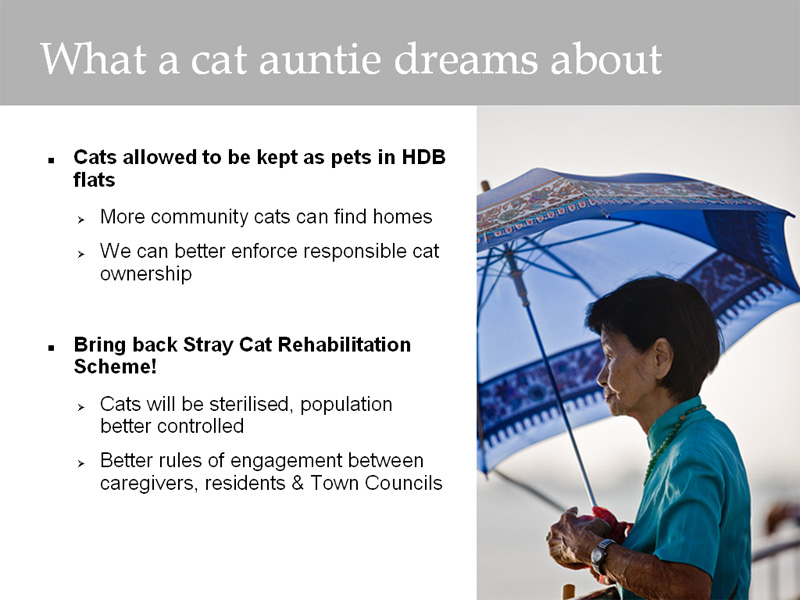
The Cat Welfare Society gave a presentation as part of the second panel session on Domestic Animal Welfare. It raised up our community's two main issues - that HDB allow cats to be kept as pets in flats and the reinstatement of the stray cat rehab scheme - amidst positive evidence of the effectiveness of sterilisation and a growing community of cat caregiving and advocacy in Singapore.

Can we make a cat auntie's dream come true?


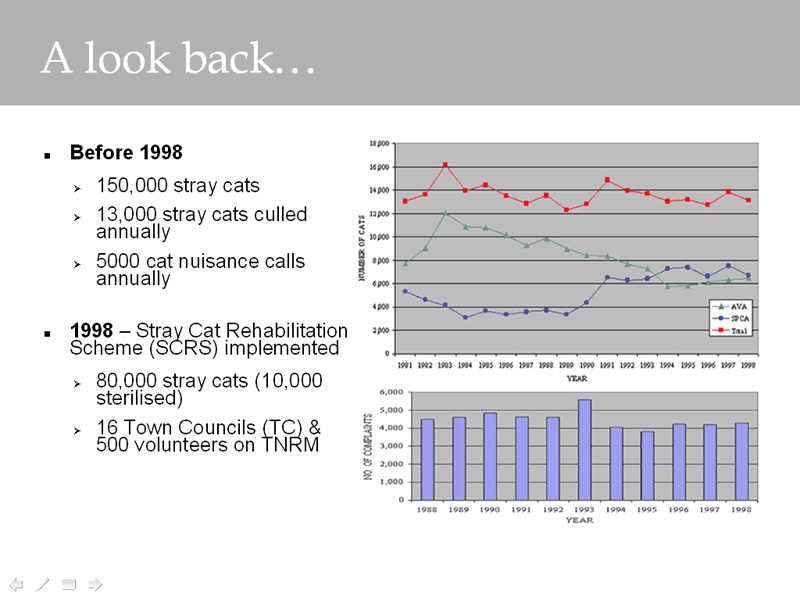
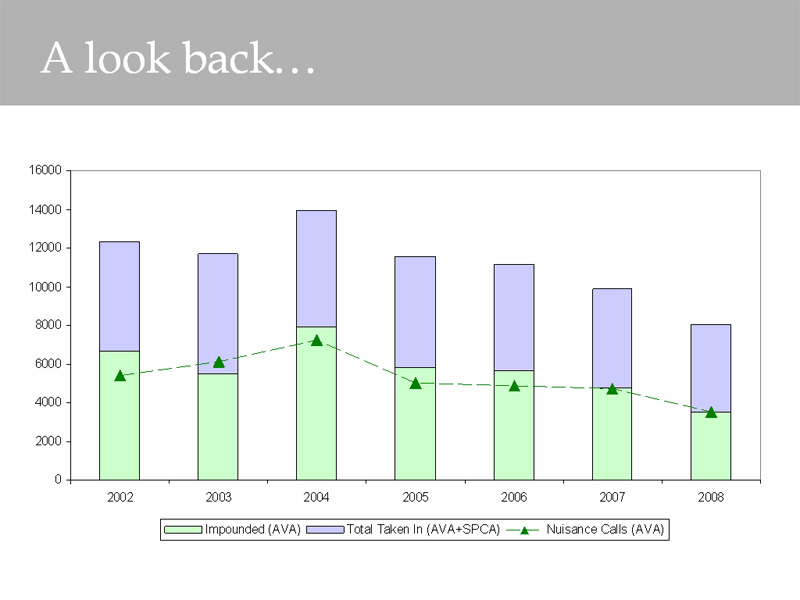
Since 2004, there has been a year on year drop in the number of cats surrendered and impounded.


Long overdue, these caregivers are starting to receive well-deserved recognition in recent years.


So, what do these community cat caregivers want? They want more eligible homes for community cats. And they want to know that their cats are safe from being indiscriminately caught and culled.


While stray cat population figures show that sterilisation is effective, what it doesn’t do is reduce the number of cat nuisance complaints, which is constantly cited as one of the reasons for resisting cat-friendly policies.


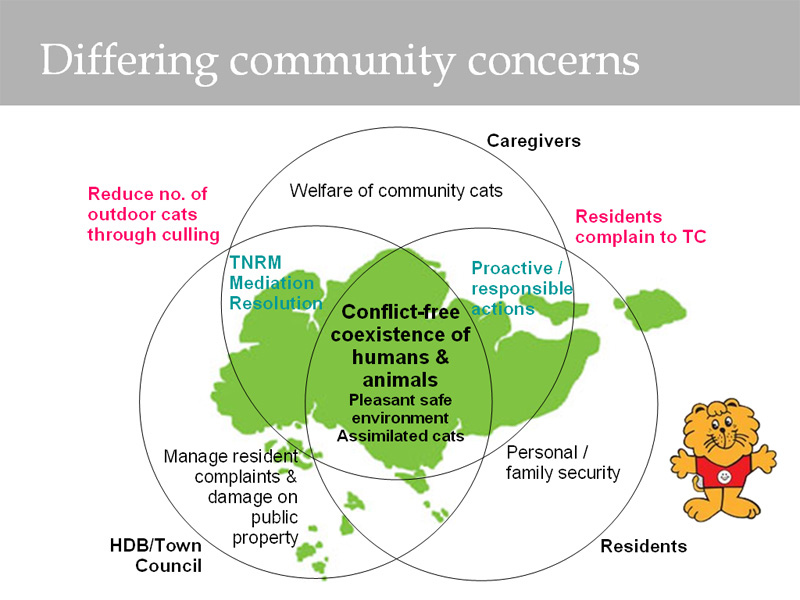
On the ground, there are many parties and their differing concerns to balance when trying to achieve an amicable level of human-animal co-existence. A lot of the resistance to the reinstating of the Stray Cat Rehab Scheme is from the town councils who are skeptical about how the scheme benefits them and also the additional workload that comes with administering the scheme.

(AVA confirmed that if they were to bring the scheme back, it would be in a decentralised form and only with the consent of the town councils.)

It reinforces the point that helping town councils reduce instances of human-cat conflicts is paramount in winning them over. And that is a task that CWS will take up this year. It is making plans to engage HDB, MPs and TCs and call for like-minded people in this community to come forward with inputs and support towards this campaign.


In contrast to the stray cat, stray dogs remain far less tolerated on our streets. The govt still does not recognise the same trap and neuter programme for our canine friends. Yet the pet dog trade trumps the cat anyday.

Singapore being a free market, the govt does not interfere with the market supply of pets from breeders or in pet shops. Many advocates argued that more must be done to curb the supply, especially in the face of a growing number of abandoned pets in Singapore, many more dogs and an alarming number of pedigrees.

This would be music to our ears certainly but as unlikely as it is that the govt will restrict the trade in pet animals, they must at least answer for how well these animal traders are being policed. It became clear that AVA relies on whistleblowing to keep these traders in check.

As the day progressed, several areas of overlap surfaced that animal welfare groups could potentially collaborate on:

1) Allowing more categories of pets to be kept in flats like cats and medium-sized dogs.
2) Regulating the loaning of traps to the public for errant cats and monkeys.
3) Policing of unscrupulous breeding and trading of animals.

To their credit, AVA indicated a willingness to continue the dialogue beyond the symposium on many of the issues raised. One person from the floor said it best. She asked AVA to tell us how we, the animal welfare community, can help them make some of these long-awaited changes a reality. And this is an opportunity that AVA cannot quite afford to pass up.

Students made up a large percentage of the audience at the symposium, many recipients of the animal protectors grant with an impressive showing at the event. These student leaders and activists with a passion for animal welfare are likely to become our next generation of veterinarians and advocates. If AVA wants these future leaders in their fold and not on the opposite side of the table, this is the time to engage them.

And what these students want is the confidence that the govt and its policies can change. More than that, what they want is to be part of the movement that leads and that inspires the conscience of this country for animal welfare and for conservation, not trail behind it. You can just see it in their eyes.

Friday, May 22, 2009

Singapore Animal Welfare Symposium 2009

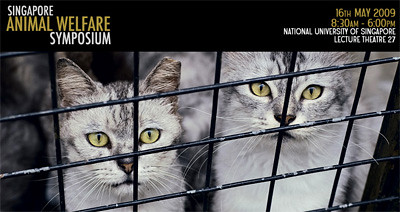
The 2nd annual Singapore Animal Welfare Symposium was held last Saturday 16 May 2009 at the National University of Singapore. There were 2 panel sessions, one on Wildlife in Entertainment and the other on Domestic Animal Welfare.


Various issues were brought up about animal performances and arguments were bandied about the necessary public education and awareness aspect of these performances against the moral question about whether it is humane to train animals to perform unnatural behaviors for education, entertainment and revenues.

While this debate will certainly continue beyond the walls of the symposium, one pertinent question did come up that provides a practical handle on why rational sounding policies are so problematic when seen from the ground level. Senior-level management of entities like the Singapore Zoo and AVA, by nature of their profession and their position are grounded in a deep understanding of animal welfare issues and do, within parameters, aim to preserve and uphold these values on an organisational and national level.

Where it often falls apart is how these policies and values are translated on a day-to-day operational level. Which begs the question, is the staff on the ground reasonably qualified, indoctrinated and trained to execute these policies and practices with the same comprehension? The answer was that there is always room for improvement.

If improvement is what they seek, the animalfamily would like to highlight that this goes beyond the question of staff selection, qualifications and training, to empowerment. Is there sufficient empowerment for the staff to provide the kind of discernment and compassion on the ground that goes a long way on an emotional issue like animal welfare? Organisations dealing with animals certainly cannot be run like other govt agencies. Their ground staff cannot be like the many mindless administrators in so many govt offices, but be recognised and managed like what they really are, the keepers and custodians of countless lives every single working day.


I see two fronts that animal welfare advocates can and should pursue. One, to engage on a policy level, and the other, to hold agencies accountable for the execution of policies to a standard that even comes close to justifying their rationale.

There is a temptation for advocates to lump the two and to use unacceptable ground practices to make the leap towards calling for policy about-turns. And that’s where they run into a brick wall.

Ultimately, there is a time for discussing policy and there is a time to simply call out undesirable practices like use of withdrawal of food and coercion on performance animals and loaning traps without proper checks and investigation, for what they are - counter-intuitive to

# Safeguarding the health of animals, fish and plants.
# Building a positive image and enhance community outreach.
# Promoting animal welfare.
# Optimising the utilisation and return on resources.


Because they said it, we didn't.

(to be contd)

Wednesday, July 18, 2007

Save the bears, Save the world

Join the Save the Bears, Save the World Meme and pledge an action that will help free bears in China from being farmed for their bile.

It is a terrible life for them in cages so tiny they cannot stand or turn. In addition, catheters are permanently stuck in their side to drain bile from them.

Help Animals Asia rescue and rehabilitate these bears. Let them live out their lives with dignity and happiness in a sanctuary.


List yourself and your friends you have tagged here and add their permalinks (pledges optional):

1. My Cat's Cove
2. V's Spot
3. KXBC
4. Foster Cat
5. Cat Tales
6. Animal Family's meme

Spread the word and happy tagging!

Wednesday, November 16, 2005

long tail macaques

the woman volunteers at the zoo today at the wildlife story telling station. she finds out that around 80 of our poor friends the long tail macaques are culled every year due to public complaints. There are just 800 left in our forests. Sadly for certain condo residents and golfers, these beautiful indigenous creatures are regarded simply as pests. when AVA is called down, it is often a death sentence for the offending animal as once they are caught, no one really knows what to do with them.

unpleasant human-monkey encounters are caused partly by insufficient growth of fruits in the forest, which brings the macaque population to the fringes of the forests, but mainly because these monkeys have learnt to associate humans with food, particularly the delivishly sugary, salty, MSG kinds.

what we can do to save these macaques is simply to stop feeding them, plant more trees (join in the effort on 27 Nov at the zoo!), and to stop complaining.

whining residents and golfers seem to think "the forest has moved pal, so should you." well it doesn't quite work that way.

yet it makes sense that people who choose to live or play near nature, love nature, doesn't it? they certainly love it enough to pay a premium for a little heaven in those biomimetic developments by the nature reserves that are painstakingly expensively internationally acclaimed-ly designed and engineered to look just like the real thing! "invite nature in for breakfast," they scream on their advertising brochures!

no wonder the wildlife is confused.

these people do love nature. the disney version. they should go live in a theme park instead.

Thursday, September 01, 2005

don't support the pet trade

lana has hernia and the vet says it is very common among pedigrees. the man's friend asks the breeder to pay for the surgery but is rejected and lana is returned to the breeder.

as a stray, i have my own bitter reasons for being against the pet trade. but this gives me a couple more. firstly, it cannot be a good thing to force genetics in the way a breeder does to produce a required aesthetic and temperament in an animal. many of these pure breeds have little genetic resilience and get sick at a drop of a hat.

secondly, i wonder what they do with pups that cannot be sold because they are not cute enough, they stay too long on the shelf and get too old, or worse, have some major defect. it is dangerous when an animal becomes a commodity because they get treated like one.

  • 20 Good Reasons Not to Support the Pet Trade
  • Animal Aid: Pet Trade
  • Wednesday, August 31, 2005

    things that turn a heart cold

    the woman googles animal abuse after reading this blog entry Animal Cruelty in Singapore is considered no big deal and finds the following:

    Animal Abuse & Human Abuse: Partners in Crime
    PETA People for Ethical Treatment of Animals

    The PETA Media Center has this to say:

  • "Anyone who has accustomed himself to regard the life of any living creature as worthless is in danger of arriving also at the idea of worthless human lives," wrote humanitarian Dr. Albert Schweitzer.

  • Parents who neglect an animal's need for proper care or abuse animals may also abuse or neglect their own children. Some abusive adults who know better than to abuse a child in public have no such qualms about abusing an animal publicly.

  • Schools, parents, communities, and courts who shrug off animal abuse as a "minor" crime are ignoring a time bomb.

  • ... children should be taught to care for and respect animals in their own right. After extensive study of the links between animal abuse and human abuse, two experts concluded, "The evolution of a more gentle and benign relationship in human society might, thus, be enhanced by our promotion of a more positive and nurturing ethic between children and animals."

    if i were the judge for the cruelty case with the Alaskan Malamute, I would similarly fine him $3000 to cover my precious time spent in court on him. i would also have him donate $7000 to SPCA or Action for Singapore Dogs dedicated to efforts on uncovering other errant pet owners like him.

    a jail term would be largely punitive. i will give it to him anyway in hopes of deterring other morons cut from the same mold. but for the sake of his future pets and his family, i would make him undergo psychiatric evaluation, get some empathy training and do community service with an animal hospital or organisation for a year. he will also not be allowed to have a pet unless certified human again by professional psychiatrist.
  • Wednesday, August 10, 2005

    no good pets

    the woman catches Tooty grooming and playing little animal games with Leafty. Fruity wants to play too but cannot read him as well and he ends up running from her.

    social skills are a learnt skill and that applies to us animals too. i am much too old to start being all accomodating and affectionate but the three younglings are learning and seem to be taking cues from the more astute Tooty. i am slowly learning too the rules of social engagement with the man and woman, and the other animals in the family.

    but still i don't see myself as belonging to anyone, not even the man and woman. that is the way a cat is. i am slowly but surely being tamed but as to whether i am a pet? yes, in the sense that someone is responsible for my health and wellbeing. no, in the sense that no one dictates what i can or cannot do, where i can or cannot go, except me.

    so i tend to agree with my detractors. it is not in my nature to be an indoor pet. then again, i won't call a dog an indoor pet either. they need their share of fresh air and wide open spaces. difference is, they want human companionship more and is far more willing to sacrifice to get it.

    yet cats like most anyone respond to kindness. we form attachments and we don't take them lightly. i love my walks, but i know where i want to call home. when the man or woman calls, i traipse back. when i wake up perturbed sometimes, i go back to sleep only when i hear or see them around me. we are tamed by attachment, not ownership.

    and we feel intense loss when that attachment is broken.

    a lot of the rules that humans hold pet owners to have to do with boundaries. cats, dogs, rabbits, do not understand boundaries like humans do. territories yes, but these we know are ever changing. it's hard to respect something we don't understand. a good pet seems to be one that is easily confined and supervised. that rules out almost everyone i know, cats, dogs, rabbits, hamsters and some fish. so there really aren't any good pets, just caged or leashed ones.

    i can only dream of a place where people and animals abide in the same space outside of the artificial rules of ownership. where a curious invigorated life is not a life at risk.

    responsibility does not equate constraint. although sadly, to many pet owners who do not want to run foul of human conventions, it is much easier to think it is so.
     

    blogger templates | Make Money Online