Showing posts with label cws. Show all posts

Friday, February 12, 2010

We created the problem. Why should they have to pay for it with their lives?

The burden of stemming the tide of destruction largely falls to cat caregivers – regular people with a big heart.

MEDIA RELEASE
Singapore, 10 February 2010 | For Immediate Release

The proliferation of stray animals in our communities is a human-created problem. They are here as a direct result of human-driven activities – a thriving live pet trade, irresponsible breeding and pet abandonment. As we enter the year of the Tiger, animal welfare agencies and organisations have a big concern - the number of animals that are going to be cleaned out with the trash during spring cleaning. This trend is mirrored in more than one turning of the year on a multi-cultural calendar – Hari Raya and New Year’s Day. And we are already seeing it happen with the next Chinese New Year around the corner.

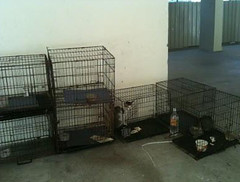
On January 30 2010, 8 cats were abandoned in their filthy, rusty cages. When community cat caregivers received the tip-off, only 2 very frightened cats remained. The rest had gone to hide in the drains. Our experience with home cats that have been abandoned is that they have very little chance of survival. Some stay put in their hiding spot refusing food until they waste completely away.


Cat caregivers are those who sterilise and manage their community cats and work closely with the Town Council to resolve cat-related issues. They are volunteers who give of their own time and resources to care for the welfare of community cats.

The current measures in addressing the problem of stray cat proliferation includes

Pet Cat Ownership
* Improving standards and practices of pet shops by the Agri-food & Veterinary Authority (AVA)
* Education and awareness campaigns on responsible pet ownership by government agencies and animal welfare organisations
* Banning cats from public housing by the Housing & Development Board (HDB) (therefore pet cat abandonment is not a crime)
* Face-to-face mediation with cat owners, sterilisation assistance and rescue efforts by cat caregivers with the support of the Cat Welfare Society and the Society for the Prevention of Cruelty to Animals (SPCA)

Stray or Abandoned Cats
* Sterilisation of community cats by cat caregivers with the support of SPCA and the Cat Welfare Society. Approx. 4200 sterilised through the support of the Cat Welfare Society and SPCA in 2008.
* Boarding at overtaxed animal shelters in Singapore
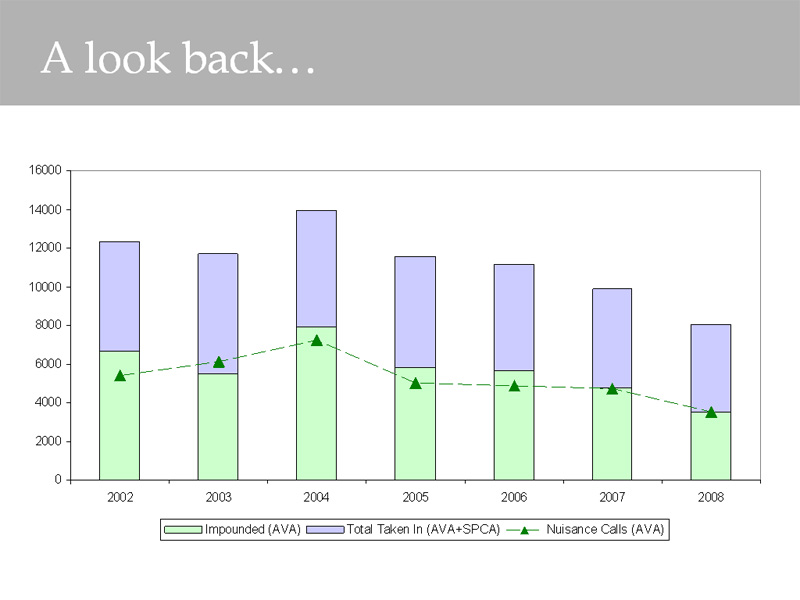
* Surrendering of animals and destruction at the Society for the Prevention of the Cruelty to Animals (SPCA) – Approx. 4500 surrendered in 2008
* Impounding and destruction by the - AVA Approx. 3500 culled in 2008

And still we had to put down 8000 cats last year. An average of 10,000 cats has been put down every year for the last 10 years.


The current measures put the considerable burden of addressing the problem of irresponsible cat owners squarely on cat caregivers. They also offer irresponsible cat owners an easy way out by abandoning and surrendering without consequences. The number of cats destroyed is gradually coming down, but the burden on cat caregivers continue year after year. The decreasing numbers is also a testimony to their efforts.

Many cat owners are driven to keep cats to save them from the streets, pest control and abuse. The percentage of people with local cats picked from the streets far outweighs the ones with pedigrees. Not regulating ownership not only penalises responsible owners who help keep cats off our streets, it puts irresponsible owners out of reach of the long arm of enforcement. Currently, government action against cat owners is confined in large degree to eviction. The pet cats then often join the community cats on the street.

Addressing the problem of irresponsible supply and demand, breeding and abandoning of pets has to come from a direct and concerted effort by government agencies, animal welfare organisations and the community of concerned citizens and pet owners, through legislation and enforcement, awareness and education and community peer pressure.

It is our aim at the Cat Welfare Society to support this steadfast and devoted community. We are celebrating their labours, the spirit and their compassion at the Tiger Show.

More information about the event at www.catwelfare.org.

Singapore's first Tiger Show


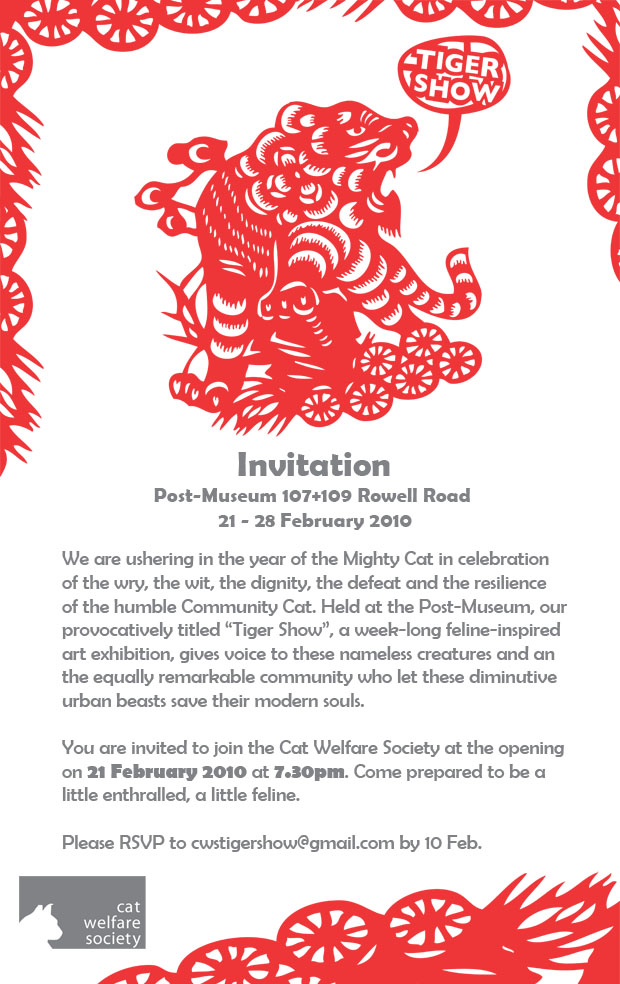
The Cat Welfare Society, together with the Post-Museum, is organising a week-long art and advocacy event from 21 - 28 February 2010.

The provocatively titled "Tiger Show" welcomes the year of the Mighty Cat in celebration of our humble Community Cats. It will bring together people from all walks of life who have a passion for animal welfare, and most certainly, a soft spot for our feline friends, to gather, to share, to learn and to party!

The line-up for this exciting week is as follows:

21 Feb (Sunday) 7.30pm - The Tiger Show Opens
Join us for the opening of our week-long feline-inspired Art Exhibition and Bazaar!
Free, by invitation.

The show is a gathering of renowned cat artists like Paul Koh of Catmasutra, Ng Ling Tze of Sloth Studios, the team from Cats of the World as well as other local artists like multi-disciplinary visual artist,Tay Bee Aye and ceramist, Michelle Lim. Many feline-inspired collectibles will also be on sale at the show!

Exhibition opening hours 6-10pm (Tue-Fri), 12nn-10pm (Sat-Sun).

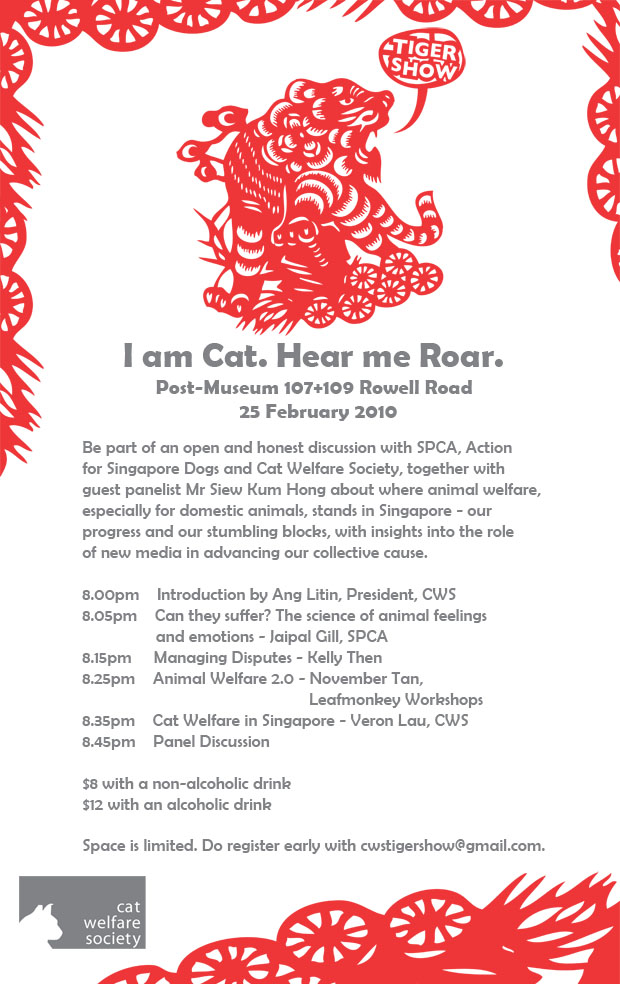
25 Feb (Thursday) 8.00pm - "I am Cat. Hear Me Roar"
An advocacy and mediation workshop for the welfare of cats

Be part of an open and honest discussion with SPCA, Action for Singapore Dogs, Cat Welfare Society and guest panelist Mr Siew Kum Hong about where animal welfare, especially for domestic animals, stands in Singapore - our progress and our stumbling blocks, with insights into the role of new media in advancing our collective cause. Our line-up of speakers include Jaipal Gill from SPCA who will be speaking on animal sentience, Kelly Then on managing disputes and November of Leafmonkey Workshop on new media advocacy.

$8 with a non-alcoholic drink
$12 with an alcoholic drink


26 Feb (Friday) 7.30pm Animal People Singles' Night!

It's a party so let the fur fly. It's time to break out the alcohol and the party heels. If you have ever lamented that you met this wonderful person to find out they hate your dog or your hamster, you won't have this problem here. And did we mention the vivacious Maia Lee is performing? (Strictly humans tonight, please!)

$12 with first drink

28 Feb (Sunday) 12 - 5pm Cat's Day Out

We are reviving this popular gathering of cat people and their cats! Join our favourite host, Melody Chen in search of the most beautiful domestic cat that day! Also look out for cat grooming services, cat and owner photo portraiture taking, cat training workshop and a very special symposium cum visual performance by the one and only Smiling Yogi Bala Matchap -- Cat Yoga!

$30 per ticket (for one person accompanied with or without one cat. Tickets for each additional cat is $5)

Register early!
Space is limited so register with cwstigershow@gmail.com early.
Visit their Facebook Event Page to leave a comment and word of support!


Friday, June 26, 2009

CWS: A Look Ahead

Cat Welfare Society has had a solid month of fundraising with the LPN Cat Day at Suntec City, the Cat’s Night Out “In Search of the Most Beautiful Domestic Cat” at Jurong Point and that unforgettably tongue-in-cheek STrip “What’s New Pussycat?” campaign.
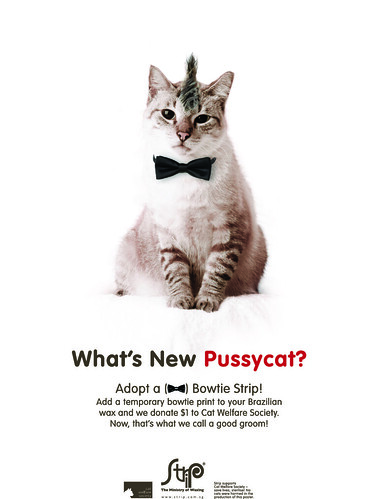

Besides raising funds for stray sterilisation, these light-hearted occasions gave us a rare chance to let our hair down with other cat groups, volunteers and with the public.

Now the fun is over, it is time to get back down to the serious business of cat welfare.

Engaging govt agencies

CWS is planning a series of engagements with AVA, HDB and Town Councils. And it cannot be timelier that Sunday Times dedicated a full page on animal welfare last weekend, giving voice to the poisoned bayshore cats, abandoned animals and tireless animal welfare volunteers.

(They had to juxtapose it with an article on our good friend Mr TTK to provide a perfunctory journalistic balance to the spread, but that is easily forgiven. A contrary article on a less controversial figure would have been more detrimental. So thank you, Sunday Times.)

Also featured in the full page coverage is a small victory for cat welfare. AVA has put it on record, “AVA… is again open to subsidising the cost of sterilisation of stray cats, if caregivers, town councils and communities are willing to participate.”

So our upcoming meeting with them can now fast track to the mechanics of the stray cat sterilisation scheme: what is required of town councils and volunteers, and how to streamline the scheme for greater success.

After which, we can start working with dedicated caregivers whose stray management work in their areas through Trap-Neuter-Release-Manage or TNRM, mediation and community building work has reached a healthy maturity. We will talk to their Town Councils first.

How you can help:
If you are a caregiver with a well managed cat community, come forward. Also start keeping records of the number of cats in your neighbourhood, the number of cats you have sterilised, your encounters with Town Councils and the number of complaints handled as these will go a long way when we engage them.

If your area does not have a TNRM programme, start one! Look out for our upcoming stray cat management workshop and meet-up on how to get started.

Sterilisation

CWS continues to single-mindedly put our funds into subsidising the sterilisation of stray cats. All our fundraising efforts are for this very purpose.

We get appeals from time to time to provide financial help for caregivers in need and for cat rescues. And this the committee members and volunteers do on our own personal basis.

The reason CWS funds are not diverted that way is this: The cold honest truth is that we have had to dig into our reserves last year to cover sterilisation and medical subsidies. And one had to go. It is a sign of the times that donations are down and reimbursements for subsidies are up.

We must keep stray cat sterilisation going simply because sterilisation makes the biggest impact to the welfare of our cats in the long run. It is this consistent, demanding, unglamourous work by dedicated caregivers and volunteers that provides a compelling reason for AVA to enter into a dialogue with cat welfare advocates. And we cannot afford to derail now.

The moment the government finally takes on the funding of stray cat sterilisation, that will really open up everyone’s resources to help the sick and suffering.

That moment is close and what will get us there is to make sure more community cats are sterilised and managed.

How you can help:
Start a TNRM programme in your neighbourhood. The next best thing is to sponsor a sterilisation!

Mediation

This is something that we struggle with immensely because we don’t have a full-time person in CWS. The committee members and volunteers handle our cases after hours or through phones and emails.

Mediation remains the most stressful, unrewarding part of cat welfare work. Being yelled at by irate people with cat pee on their slippers after a long day at work is not anyone’s idea of a fulfilling existence. But we still do it, together with our network of caregivers and volunteers because it goes hand in hand with TNRM. Stray management just doesn’t work without it.

What we find is that people come to CWS for a magic pill. And five after-hours dispensers to pill an entire nation is beyond ridiculous. We need more mediators.

It is a fact that Singaporeans hold an uncanny esteem for authority. People from an organisation are often seen as more respectable than someone from the neighbourhood. That is how Singaporeans work, so “I am from Cat Welfare Society” goes a long way. But anyone with the passion, a little gumption and knowledge can register with CWS and fulfill this role. And all the better if they are actual residents in the neighbourhood.

These resident mediators have their nose on the ground, they get to the problems quicker and they can better establish long term relationships with the Town Council officers and other residents. Town Councils can’t ignore them simply because they are residents, therefore constituents and more importantly, voters.

The magic pill? Don’t yell back and don’t wear your house clothes when mediating.

As much as mediation is daunting and completely thankless, just a word from you can save a cat from being caught and culled. If you are lucky, you can instill a little conscience in the neighbourhood, one cheesed off resident at a time.

How you can help:
If you want to be a mediator for your neighbourhood, register with CWS and contact your Town Council officer. Also look out for our upcoming stray cat management workshop and meet-up on how to get started.

Beyond CWS

If you have been following the posts and thread on the Cat Welfare Society’s Facebook page, you would have a good idea of the spectrum of cat welfare activities required to fully tackle an issue as broad as cat welfare.

There are the numerous appeals for medical fees for sick or injured cats, the many catteries and shelters in trouble in these tough economic times, cats and kittens that need fosterers and homes, AVA officers and Town Council officers to negotiate with and the unenlightened public to educate. As individuals, where do we start?

My own experience with the animalfamily is to start where your passion takes you. I started with the rescue and adoption of an old mangy toothless cat that stole my heart.

6 years on, the family has 10 cats at home, 40 cats fostered (and thankfully rehomed), hundreds sterilised and we dream of a cattery. We have seen cat shelters and their antithesis, cat hoarders and left a part of ourselves with each and everyone of these animals, the cheery ones, the sadly neglected, the dying and the dead.

Still, it is not enough. There must be a more sustainable solution to the plight of our cats, the kind that makes it less necessary to take cats off our streets for anything other than to loving homes. This will happen only when the responsibility for stray cat welfare is not just on caregivers but the entire nation. That is the prize worth working towards.

Tuesday, May 26, 2009

Singapore Animal Welfare Symposium 2009 II

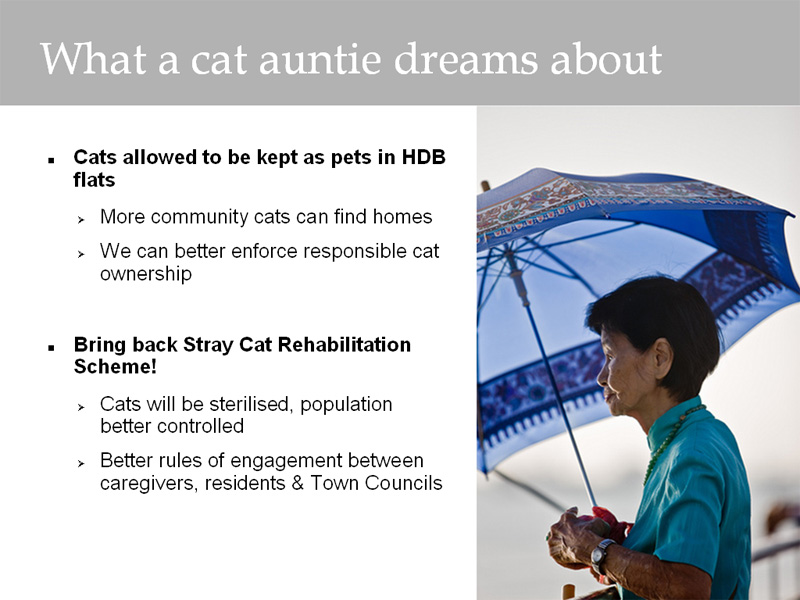
The Cat Welfare Society gave a presentation as part of the second panel session on Domestic Animal Welfare. It raised up our community's two main issues - that HDB allow cats to be kept as pets in flats and the reinstatement of the stray cat rehab scheme - amidst positive evidence of the effectiveness of sterilisation and a growing community of cat caregiving and advocacy in Singapore.

Can we make a cat auntie's dream come true?


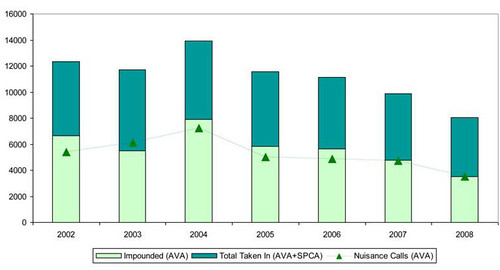
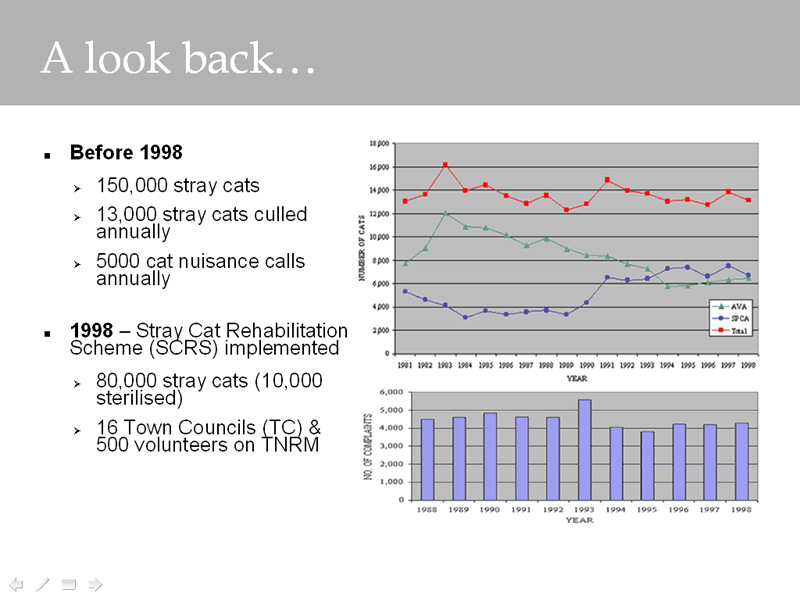
Since 2004, there has been a year on year drop in the number of cats surrendered and impounded.


Long overdue, these caregivers are starting to receive well-deserved recognition in recent years.


So, what do these community cat caregivers want? They want more eligible homes for community cats. And they want to know that their cats are safe from being indiscriminately caught and culled.


While stray cat population figures show that sterilisation is effective, what it doesn’t do is reduce the number of cat nuisance complaints, which is constantly cited as one of the reasons for resisting cat-friendly policies.


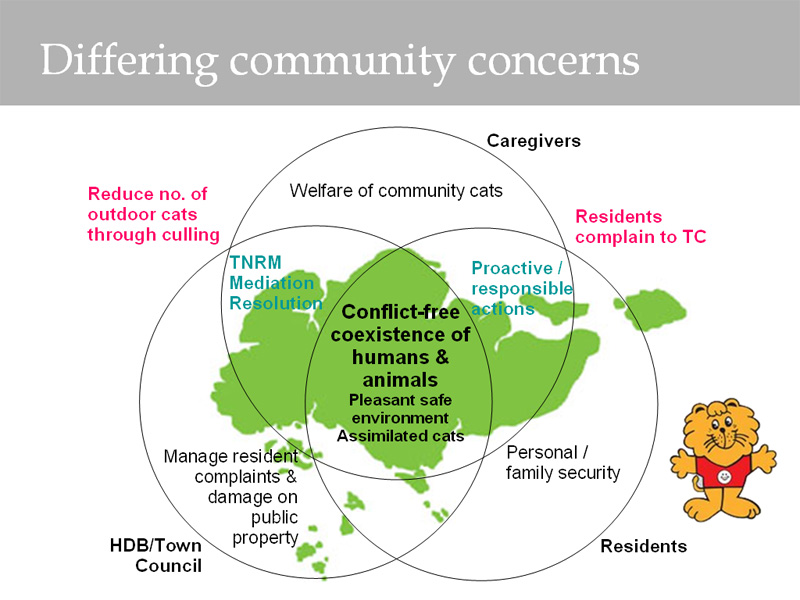
On the ground, there are many parties and their differing concerns to balance when trying to achieve an amicable level of human-animal co-existence. A lot of the resistance to the reinstating of the Stray Cat Rehab Scheme is from the town councils who are skeptical about how the scheme benefits them and also the additional workload that comes with administering the scheme.

(AVA confirmed that if they were to bring the scheme back, it would be in a decentralised form and only with the consent of the town councils.)

It reinforces the point that helping town councils reduce instances of human-cat conflicts is paramount in winning them over. And that is a task that CWS will take up this year. It is making plans to engage HDB, MPs and TCs and call for like-minded people in this community to come forward with inputs and support towards this campaign.


In contrast to the stray cat, stray dogs remain far less tolerated on our streets. The govt still does not recognise the same trap and neuter programme for our canine friends. Yet the pet dog trade trumps the cat anyday.

Singapore being a free market, the govt does not interfere with the market supply of pets from breeders or in pet shops. Many advocates argued that more must be done to curb the supply, especially in the face of a growing number of abandoned pets in Singapore, many more dogs and an alarming number of pedigrees.

This would be music to our ears certainly but as unlikely as it is that the govt will restrict the trade in pet animals, they must at least answer for how well these animal traders are being policed. It became clear that AVA relies on whistleblowing to keep these traders in check.

As the day progressed, several areas of overlap surfaced that animal welfare groups could potentially collaborate on:

1) Allowing more categories of pets to be kept in flats like cats and medium-sized dogs.
2) Regulating the loaning of traps to the public for errant cats and monkeys.
3) Policing of unscrupulous breeding and trading of animals.

To their credit, AVA indicated a willingness to continue the dialogue beyond the symposium on many of the issues raised. One person from the floor said it best. She asked AVA to tell us how we, the animal welfare community, can help them make some of these long-awaited changes a reality. And this is an opportunity that AVA cannot quite afford to pass up.

Students made up a large percentage of the audience at the symposium, many recipients of the animal protectors grant with an impressive showing at the event. These student leaders and activists with a passion for animal welfare are likely to become our next generation of veterinarians and advocates. If AVA wants these future leaders in their fold and not on the opposite side of the table, this is the time to engage them.

And what these students want is the confidence that the govt and its policies can change. More than that, what they want is to be part of the movement that leads and that inspires the conscience of this country for animal welfare and for conservation, not trail behind it. You can just see it in their eyes.

Friday, May 22, 2009

Singapore Animal Welfare Symposium 2009

The 2nd annual Singapore Animal Welfare Symposium was held last Saturday 16 May 2009 at the National University of Singapore. There were 2 panel sessions, one on Wildlife in Entertainment and the other on Domestic Animal Welfare.


Various issues were brought up about animal performances and arguments were bandied about the necessary public education and awareness aspect of these performances against the moral question about whether it is humane to train animals to perform unnatural behaviors for education, entertainment and revenues.

While this debate will certainly continue beyond the walls of the symposium, one pertinent question did come up that provides a practical handle on why rational sounding policies are so problematic when seen from the ground level. Senior-level management of entities like the Singapore Zoo and AVA, by nature of their profession and their position are grounded in a deep understanding of animal welfare issues and do, within parameters, aim to preserve and uphold these values on an organisational and national level.

Where it often falls apart is how these policies and values are translated on a day-to-day operational level. Which begs the question, is the staff on the ground reasonably qualified, indoctrinated and trained to execute these policies and practices with the same comprehension? The answer was that there is always room for improvement.

If improvement is what they seek, the animalfamily would like to highlight that this goes beyond the question of staff selection, qualifications and training, to empowerment. Is there sufficient empowerment for the staff to provide the kind of discernment and compassion on the ground that goes a long way on an emotional issue like animal welfare? Organisations dealing with animals certainly cannot be run like other govt agencies. Their ground staff cannot be like the many mindless administrators in so many govt offices, but be recognised and managed like what they really are, the keepers and custodians of countless lives every single working day.


I see two fronts that animal welfare advocates can and should pursue. One, to engage on a policy level, and the other, to hold agencies accountable for the execution of policies to a standard that even comes close to justifying their rationale.

There is a temptation for advocates to lump the two and to use unacceptable ground practices to make the leap towards calling for policy about-turns. And that’s where they run into a brick wall.

Ultimately, there is a time for discussing policy and there is a time to simply call out undesirable practices like use of withdrawal of food and coercion on performance animals and loaning traps without proper checks and investigation, for what they are - counter-intuitive to

# Safeguarding the health of animals, fish and plants.
# Building a positive image and enhance community outreach.
# Promoting animal welfare.
# Optimising the utilisation and return on resources.


Because they said it, we didn't.

(to be contd)

Tuesday, May 12, 2009

let's start a revolution

These are exciting times for cat welfare volunteers, supporters and activists. In the beginning, they started websites, then forums and they blogged. Now more than ever, they have organised themselves into a remarkably coherent voice for the common community cat in our communal void decks and on our collective streets.

The woman remembers that singular moment when her flame for cat welfare was fanned into burning scorching action. That was 5 years ago when Maneki walked into her life. Back then, it was tough to get started. Cat Welfare Society helped by providing starter packets of information but because there were never enough people to start a TNRM group in this area, it didn’t make sense for CWS to come down to conduct workshops or to make contact with the town council.

The woman had to find her own way, attend a TNRM workshop in NLB, loan a couple of traps, make herself useful to the town council officer and just get on with it.

Blogs and bloggers certainly helped along the way but cold hard information was tough to come by to paint a coherent picture of how we arrived at the present milestones in cat welfare, who are our minor and major movers in government and civil society and what are the common goals for the future.

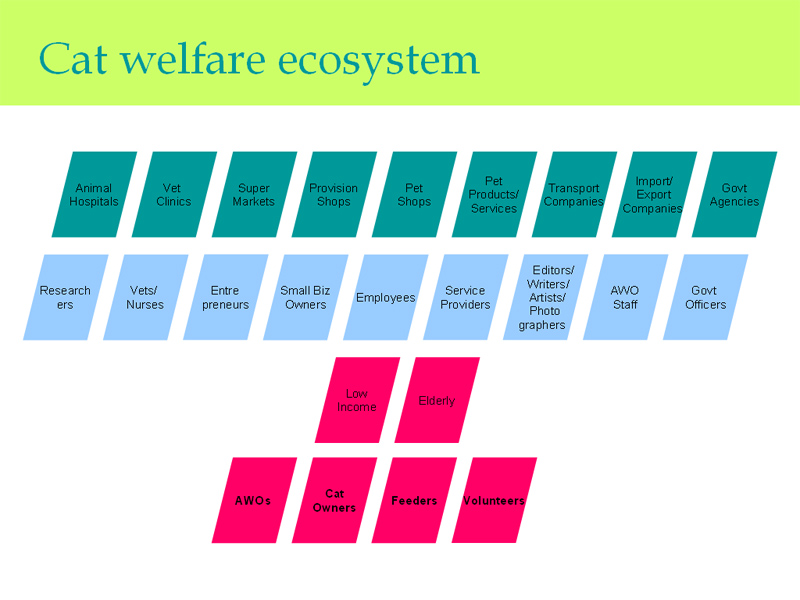
It is truly only after Facebook and the flowering connections it proffered that this organically emerging animal welfare ecosystem in Singapore is crystallising in a way that this feline hopes will inspire progressive thinking and greater action in Singaporeans for us Singaporean cats. Facebook connects people, their human faces and their stories on a level that surpasses their carefully crafted words that make up websites, blogs and forums. This has done more to move bodies of knowledge around at great speeds without saying any much more than people are already doing.

So if you haven’t found your way onto the bandwagon, maybe this is the time.

This blog has been featuring links to other animal welfare groups in Singapore since forever, it also spots a blogroll that I have just split into a local list and the rest of the world so that it is easier to monitor our very own catty echo chamber of meows and grunts.

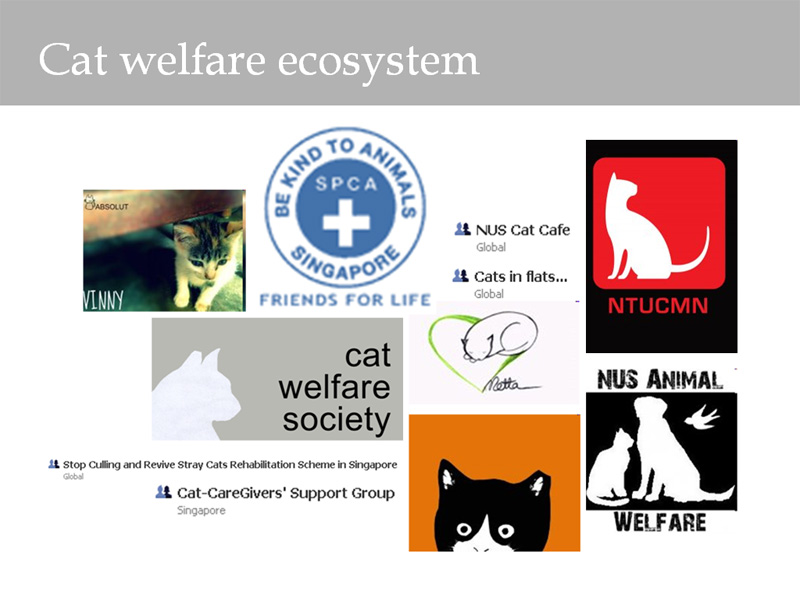
If you want to join the revolution that is happening online, here is a list of Facebook groups that you can hook up with for starters. Perhaps by chance or design, we might become mutual online friends and fans and I look forward to that.

Organisations
Cat Welfare Society Page / Group
SPCA Singapore

Issues
Appeal to the AVA to Stop the Free Loan of Cat Traps
Cats in flats...
Support Pet Shops that Do Not Sell Pets
Stop Culling and Revive Stray Cats Rehabilitation Scheme in Singapore
STOP the culling of stray cats!

Support Groups
Cat-CareGivers' Support Group
Cat Fosterers (Singapore)
TnRM (Singapore and Malaysia)
Singapore Adoption Group

Student Groups
Cats Management Network
SMU Paw
NUS PEACE! People Ending Animal Cruelty and Exploitation
NUS Cat Cafe

Other Groups
Cat Absolut
Paw Pledge
MettaCats
Blessing Home

General
Cat Lovers Singapore
Singapore Community Cats

Saturday, April 04, 2009

we are more human in a crisis

The reality of 2009 has hit home. Charity organisations are looking at their financial year-end balance sheets and balking. Donors, volunteers, are looking long and hard at their own finances and commitments. Many have lost jobs.

Animal welfare is perhaps the hardest hit for its very nature. TNP recently threw a spotlight on a jobless man in Ang Mo Kio who has 80 stray cats under his care. Reactions to the story echo a general public sentiment that the jobless man and his kind are out of their blinking minds, spending money on CATS of all things in this crisis where so many people could use that extra lifeline. This sentiment spills over to animal welfare work on the whole.

It often escapes them that quite simply, cats don’t eat money, nor dogs, birds, sharks or whales. We might try it for a lark but still perfectly legal tender following a rinse after regurgitation.

We merely ingest a small measure of raw materials that money can buy. The bulk of the money spent goes right back to people, and lots of them. If spending is the way out of this crisis like we keep getting told, animal people are certainly no small part of that equation!


Lucky for us, our caregivers are legendary for their single-minded obstinacy. No job, no money but don’t even think about suggesting that they discontinue their feeding rounds or with TNRM. They know enough from watching their cats how to gnaw the thinking parts off a cold hard household pest.

These aunties and uncles are the very people carrying the brunt of a country’s uncertain economic future, but somewhere along the line, they rejected everything that this society has taught them and made the conscious, unwavering decision to focus on something outside of themselves rather than their own problems.

In a crisis, they become more resourceful, more willing to ask for help, forming their own network of collaborators and sponsors, and taking advantage of all available subsidies from organisations like SPCA and the Cat Welfare Society. And they are doing it in english, in mandarin, in malay, in tamil and several dialects.

The way a Toa Payoh caregiver sees it, “When you have money, you have no time. When you have time, you have no money.” So they go about joining the dots between the people with money and the people with time.

All the more, they look to animal welfare organisations to provide a level playing field with their programmes and subsidies. These organisations are able to connect recipients with donors on a far larger scale than any individual or group, to the combined tune of $110,000 last year for cat sterilisation alone. This is up from $90,000 from the previous year.

And they need to meet this growing demand in good times and in bad.

If you are surviving the crisis with a little extra in your pocket, please consider giving to the SPCA and the Cat Welfare Society. Cats don’t need your money but the uncles and aunties who love us do.

Tooty would like to thank the generous people out there who contributed to the hoarding case. In particular, Cat Welfare Society, Paw Pledge and the anonymous individuals all the more noble for their anonymity.
 

blogger templates | Make Money Online